
Mount AI in Action: 262 Programmatic SEO Pages Built, Indexed, and De-Indexed
262
Pages Built
262 (100%)
Peak Indexed
68.3K
Impressions
1
Currently Indexed
The Challenge
The Programmatic SEO Opportunity
Programmatic SEO is the practice of generating large numbers of pages targeting long-tail keywords using templates, databases, and automation. Instead of writing each page by hand, you build a system that produces hundreds or thousands of pages, each targeting a specific search query. When it works, programmatic SEO can capture enormous volumes of search traffic that would be impossible to target manually.
The opportunity we identified was clear: millions of people search for "how much do [profession] make" queries every month. These queries follow a predictable pattern, making them ideal for programmatic SEO. By combining 15 business models (YouTube, freelancing, e-commerce, SaaS, etc.) with 15 niches (gaming, fitness, finance, etc.), we could generate 225 unique earnings pages (plus hub pages and static content) totaling 262 pages on a single domain.
The Goal
Test whether a brand-new domain with zero authority could scale to 262 programmatic SEO pages using LLM-generated content and achieve full indexation by Google. This was an experiment designed to push the boundaries: no existing domain authority, no backlink profile, no manual content. Just a content generation system and a solid technical foundation.
Technical Hurdles
The technical stack needed to support rapid page generation and edge delivery. We built the site on Next.js with Payload CMS as the headless content layer, backed by Cloudflare D1 (SQLite at the edge) and R2 for media storage. Cloudflare Workers handled server-side rendering at the edge, giving every page sub-second TTFB globally.
The content generation pipeline used multiple LLM prompt templates to produce differentiated content across all 225 leaf pages. Each page needed unique earnings estimates, revenue breakdowns, growth strategies, and actionable advice, not just the same template with swapped keywords.
The Risk
Google has become increasingly aggressive about what it indexes, especially since the September 2023 helpful content update. Templated content on new domains with no authority faces an uphill battle. Adding to the difficulty, all 225 earnings pages fall squarely into YMYL (Your Money or Your Life) territory, content about income and earnings that Google subjects to even stricter quality standards. The question was whether strong technical SEO, differentiated content, and a logical site architecture could overcome both the lack of domain authority and the heightened scrutiny applied to YMYL content. This was the core bet of the programmatic SEO experiment.
The Mount AI Pattern
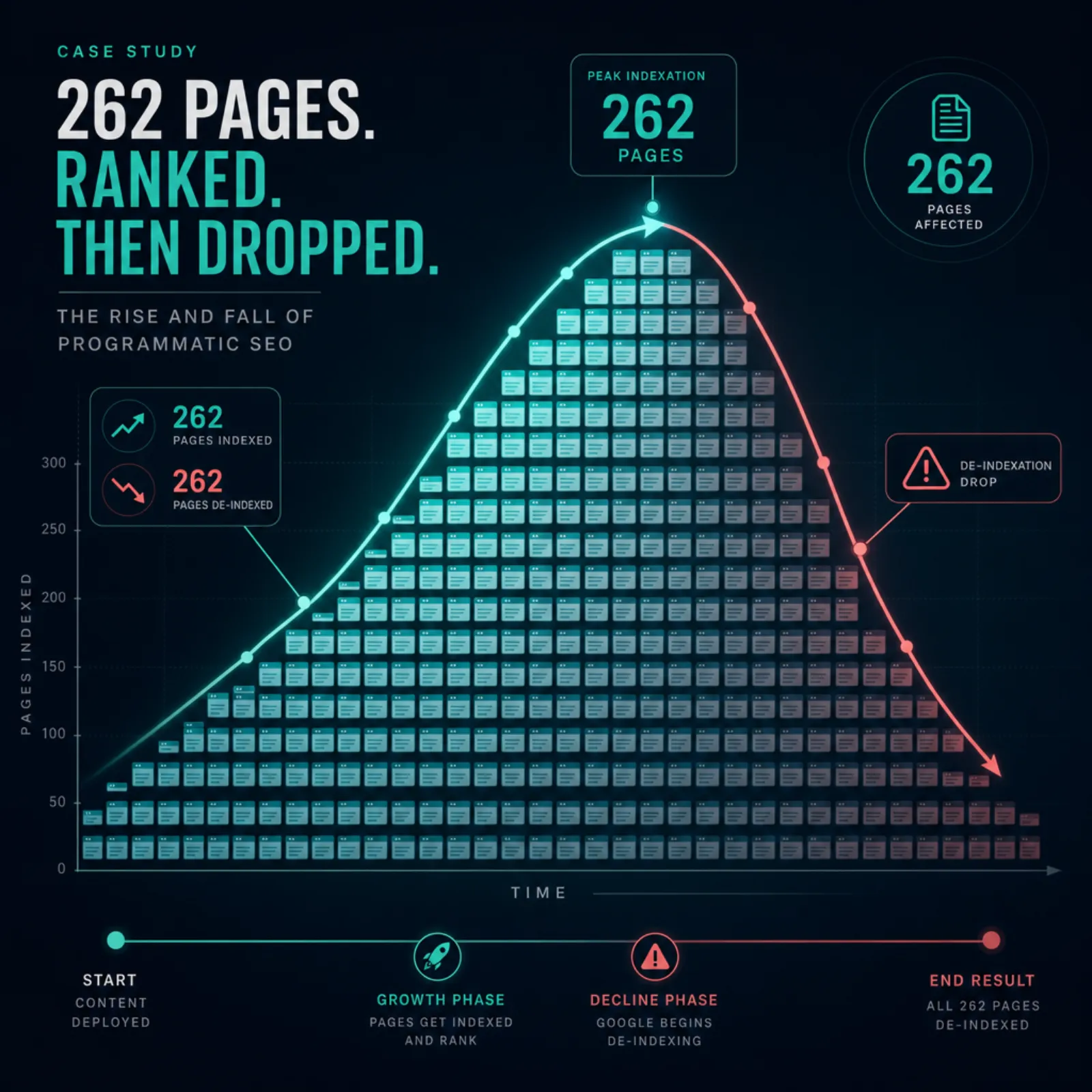
In SEO circles, "Mount AI" describes the trajectory that many AI generated content SEO projects follow: a steep climb in indexation and impressions as Google initially crawls and indexes the pages, followed by an equally steep drop as algorithmic quality filters catch up. The shape of the traffic curve (rapid ascent, brief plateau, sharp decline) resembles a mountain peak, hence the name. This programmatic SEO example would go on to demonstrate the Mount AI pattern almost perfectly, making it a useful case study for anyone considering large-scale AI-generated content.
Our Solution
Building the Content System
The 15x15 Content Matrix
The foundation of the programmatic SEO strategy was a content matrix: 15 business models crossed with 15 niches, producing 225 unique leaf pages. Each page answered a specific query like "how much do YouTube gamers make" or "how much do freelance fitness professionals earn." The matrix ensured comprehensive coverage of the topic space while maintaining a logical, crawlable structure.
Hub-and-Spoke Architecture
We implemented a hub-and-spoke site architecture designed to distribute link equity and make the site easily crawlable. Each of the 15 business models had a dedicated hub page that aggregated all 15 niche variations. These hub pages served as the primary navigation layer, linking down to individual leaf pages and cross-linking between related business models. The architecture was intentional: hub pages would (in theory) accumulate more authority and pass it down to leaf pages.
Differentiated Content Generation
To avoid triggering Google's duplicate or thin content detection, we developed 5 different LLM prompt templates, one for each business model category:
- Creator Economy (YouTube, podcasting, blogging): focused on audience monetization, sponsorship rates, and platform-specific revenue
- E-commerce (dropshipping, print-on-demand): focused on margins, supplier costs, and scaling strategies
- Content/Publishing (course creation, newsletter): focused on content leverage, recurring revenue, and audience building
- Service-based (freelancing, consulting, coaching): focused on hourly rates, client acquisition, and service packaging
- Tech/Product (SaaS, app development): focused on MRR, churn, and product-market fit
Each page generated unique 8-section content including earnings estimates with specific dollar ranges, multiple revenue sources, growth strategies tailored to the niche, and actionable next steps. The goal was to make each page genuinely useful, not just a keyword-stuffed template.
Technical Implementation
The programmatic SEO infrastructure included several systems working together:
- Google Search Console API integration: automated tracking of indexation status, impressions, clicks, and average position for every page
- Bing Webmaster Tools API: parallel indexation monitoring and URL submission
- Automated sitemap generation: XML sitemaps submitted on day one, with all 262 URLs included
- Edge rendering via Cloudflare Workers: every page server-rendered with sub-second TTFB, clean HTML output, and proper meta tags
All 262 pages were deployed simultaneously. The sitemap was submitted to both Google Search Console and Bing Webmaster Tools on the first day. This was a deliberate choice. We wanted to test whether Google would index a large batch of programmatic SEO pages at once from a new domain.
Results
Results: The Full Story
The results of this programmatic SEO experiment played out in three distinct phases, tracing the classic Mount AI arc from rapid indexation to systematic de-indexation. The story is more instructive than any pure success case study could be.
Phase 1: Full Indexation and Early Traction
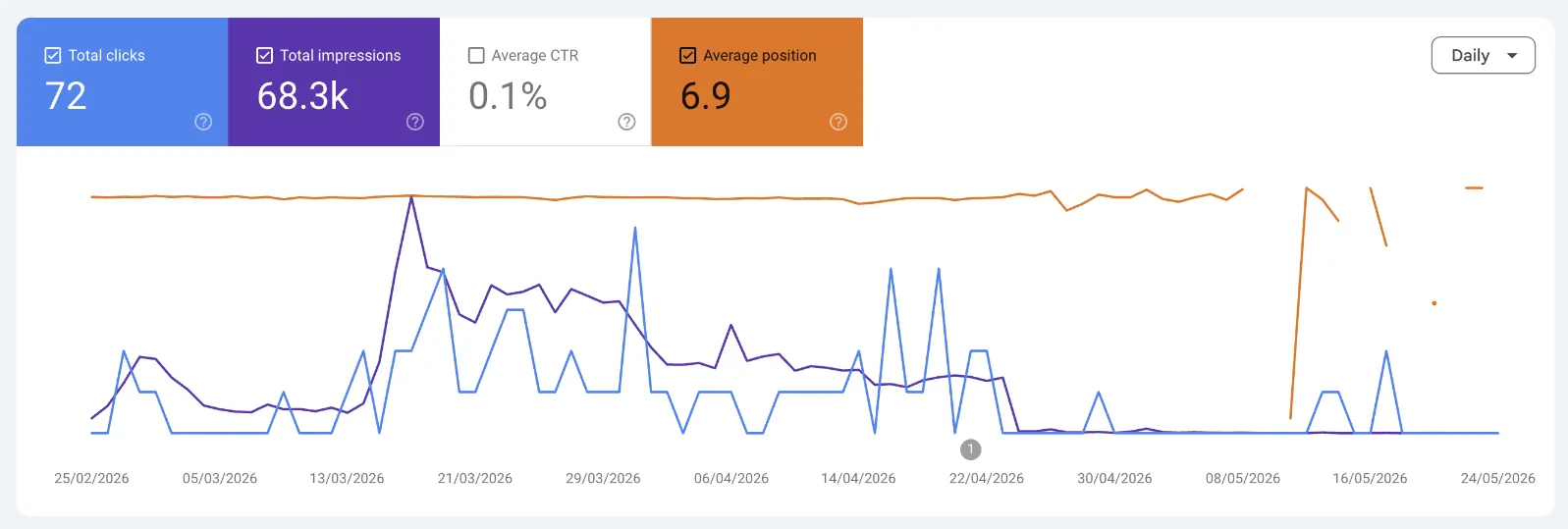
The initial results exceeded expectations. All 262 pages were indexed by Google, a 100% indexation rate. The site accumulated 68,300 impressions and 72 clicks across all pages. For a brand-new domain with no backlinks and entirely LLM-generated content, this was a strong signal that the programmatic SEO approach had technical merit.
Entertainment-adjacent niches consistently outperformed others, with the YouTube + Gaming combination leading in impressions. Google appeared to recognize topical relevance in these popular search categories. Hub pages indexed fastest, often appearing in Google's index within days of submission, while leaf pages followed over the next few weeks. This phase looked like a programmatic SEO success story in the making, the ascending slope of the Mount AI curve.
Phase 2: The Mount AI Descent (Month 1.5-2)
Approximately 1.5 to 2 months after launch, Google began systematically de-indexing the site, the descending slope of the Mount AI pattern. This wasn't a sudden penalty. It was a gradual process. Between 20 and 40 pages dropped from Google's index per day, steadily over several days, until only the homepage remained. From 262 indexed pages to 1.
The most likely contributing factors:
- Identical template structure: despite 5 prompt variations, the underlying page structure across 225 pages was similar enough to trigger Google's helpful content system
- YMYL content without authority: every earnings page falls into Google's "Your Money or Your Life" category, which faces heightened quality scrutiny. Publishing 225 YMYL pages on a brand-new domain with no credentials or first-hand experience was a significant risk factor
- Thin hub pages: the hub pages were essentially card grids linking to leaf pages, with no substantial original content of their own
- Zero domain authority: no legitimate backlinks pointing to the site, giving Google no external quality signal
- Simultaneous launch: deploying all 225 LLM-generated pages at once likely signaled automated content production to Google's systems
Phase 3: Spam Backlink Attack (May 2025)
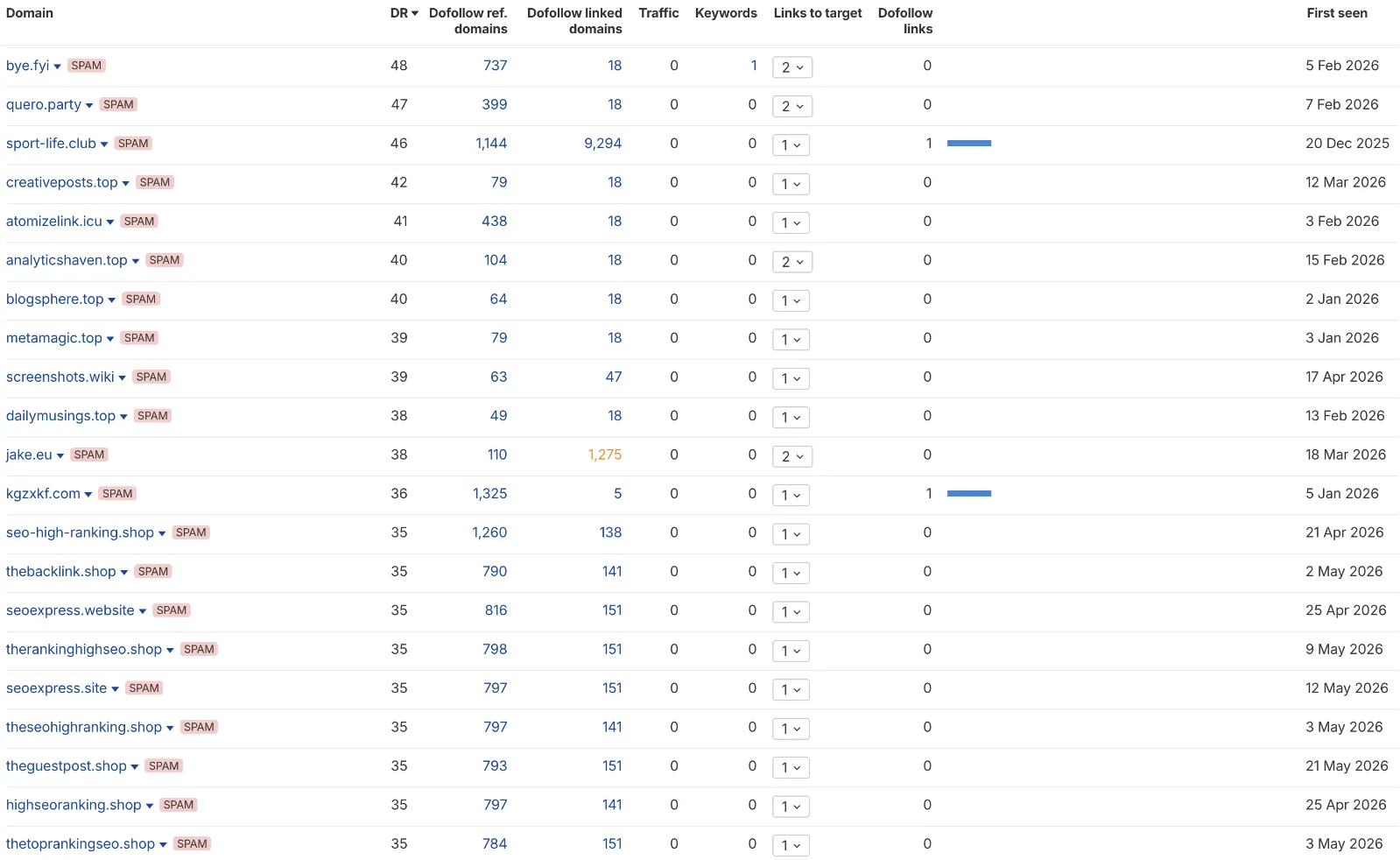
To compound the situation, hundreds of spammy domains began pointing links at the site. Over 157 domains had to be disavowed through Google's disavow tool. While it's unclear whether these spam backlinks directly caused further de-indexation or simply coincided with it, they certainly didn't help recovery efforts. The site remains at 1 indexed page despite ongoing attempts to recover.
Key Lessons for Programmatic SEO
This programmatic SEO case study produced data that's more valuable than the traffic it generated. As a textbook example of the Mount AI pattern, it offers concrete lessons for anyone planning AI generated content SEO at scale:
- The Mount AI peak is your window to act. The ~1.5 months of full indexation was effectively a probationary period, the top of the Mount AI curve. During that window, your job is to prove your site's legitimacy through backlinks, E-E-A-T signals, and content quality improvements. We didn't act on that window, and Google pulled the plug. If you're running a programmatic SEO project, treat the first weeks of indexation as your most critical period.
- Backlinks aren't optional for programmatic SEO. Without legitimate backlinks pointing to the content, Google has no external signal that the site deserves to stay indexed. Building links during the probationary window could have changed the outcome entirely. This is the single biggest lesson from the experiment.
- E-E-A-T signals matter for programmatic content. First-person perspective, author credentials, original data, and expertise signals could have differentiated the content from pure template-generated pages. Google's helpful content system specifically looks for these signals, and programmatic SEO pages need them even more than manually written content.
- YMYL content demands extra credibility. Earnings and income content sits in Google's highest-scrutiny category. Programmatic SEO targeting YMYL queries needs demonstrable expertise, original data, and real author credentials from day one, not just well-structured templates.
- Template diversity isn't enough. Even 5 template variations couldn't prevent detection at scale. The content needed to be genuinely unique in substance, not just structurally different. Future programmatic SEO projects should incorporate original data, user-generated content, or other signals of genuine uniqueness.
- Don't launch all pages at once. Start with 20-30 pages, build some authority and backlinks, then scale gradually. A phased rollout gives Google time to evaluate your content quality before you scale.
- Hub pages are essential and should contain real content. They indexed fastest and at the highest rate. But they need substantial, original content, not just link grids. Hub pages in a programmatic SEO architecture should be your strongest pages.
- Build linkable assets before scaling content. Calculators, interactive tools, original research, and data visualizations give other sites a reason to link to you. These should be in place before you deploy hundreds of programmatic pages.
- Monitor for negative SEO. Spam backlinks can compound existing problems. We had to disavow 157+ domains. Regular backlink monitoring should be part of any programmatic SEO operation.
Note: these are observations based on the data, not certainties. We can see the facts: the site was fully indexed, then systematically de-indexed in a classic Mount AI trajectory. The specific triggers remain Google's black box. What we can say with confidence is that programmatic SEO on a new domain without backlinks and authority carries significant risk, and the window to establish legitimacy is shorter than most people expect. We share this programmatic SEO example so others can learn from the data rather than repeat the same mistakes.
“This experiment traced the full Mount AI arc: rapid indexation, brief plateau, then systematic de-indexation. It proved that programmatic SEO can generate early traction, but without domain authority and content differentiation, Google will pull the plug. The data is more valuable than the traffic ever was.”
Arnjen Joosten
SEO Consultant & Founder, arnjen.com
Ready to grow your business?
Get a free consultation and discover how we can help you reach your marketing goals.