How to Reduce Customer Acquisition Cost: 9 Strategies That Work Across Channels
Customer acquisition costs climbing? Learn 9 proven strategies to lower CAC across paid media, SEO, email, and CRO without sacrificing growth.
Atastic Team
Digital Marketing Agency
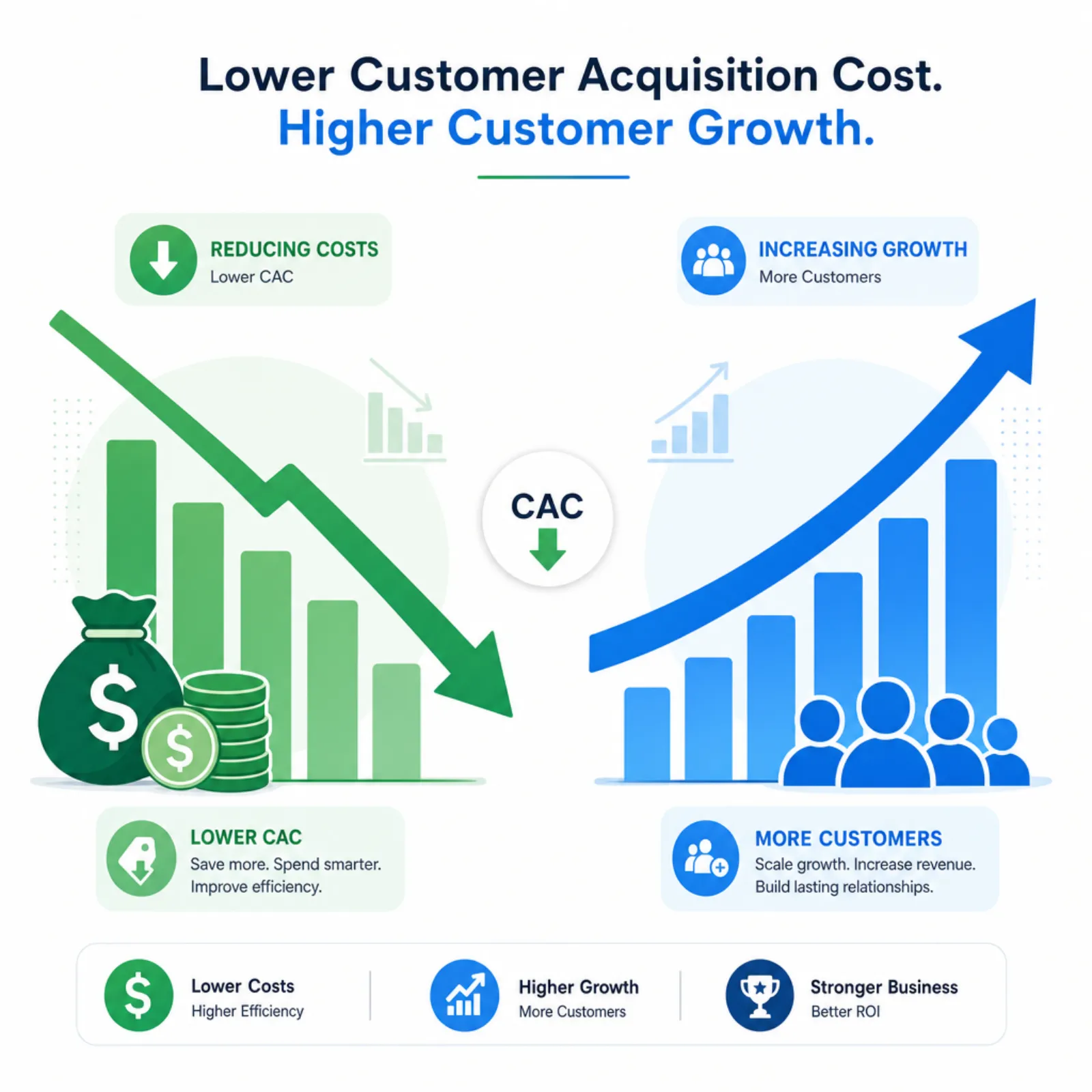
Customer acquisition cost (CAC) is one of the most important metrics in your business. It determines how much you spend to gain each new customer, and when it climbs too high, it squeezes margins, limits growth, and makes scaling unsustainable.
The challenge is that CAC tends to rise over time. Ad costs increase as competitors enter your market. Easy-to-reach audiences get saturated. Channels that once delivered cheap conversions become more expensive. If you're not actively working to reduce CAC, it will drift upward on its own.
This guide covers 9 strategies that reduce customer acquisition cost across channels, from quick tactical fixes to structural changes that lower CAC permanently.
What Is Customer Acquisition Cost (and How to Calculate It)
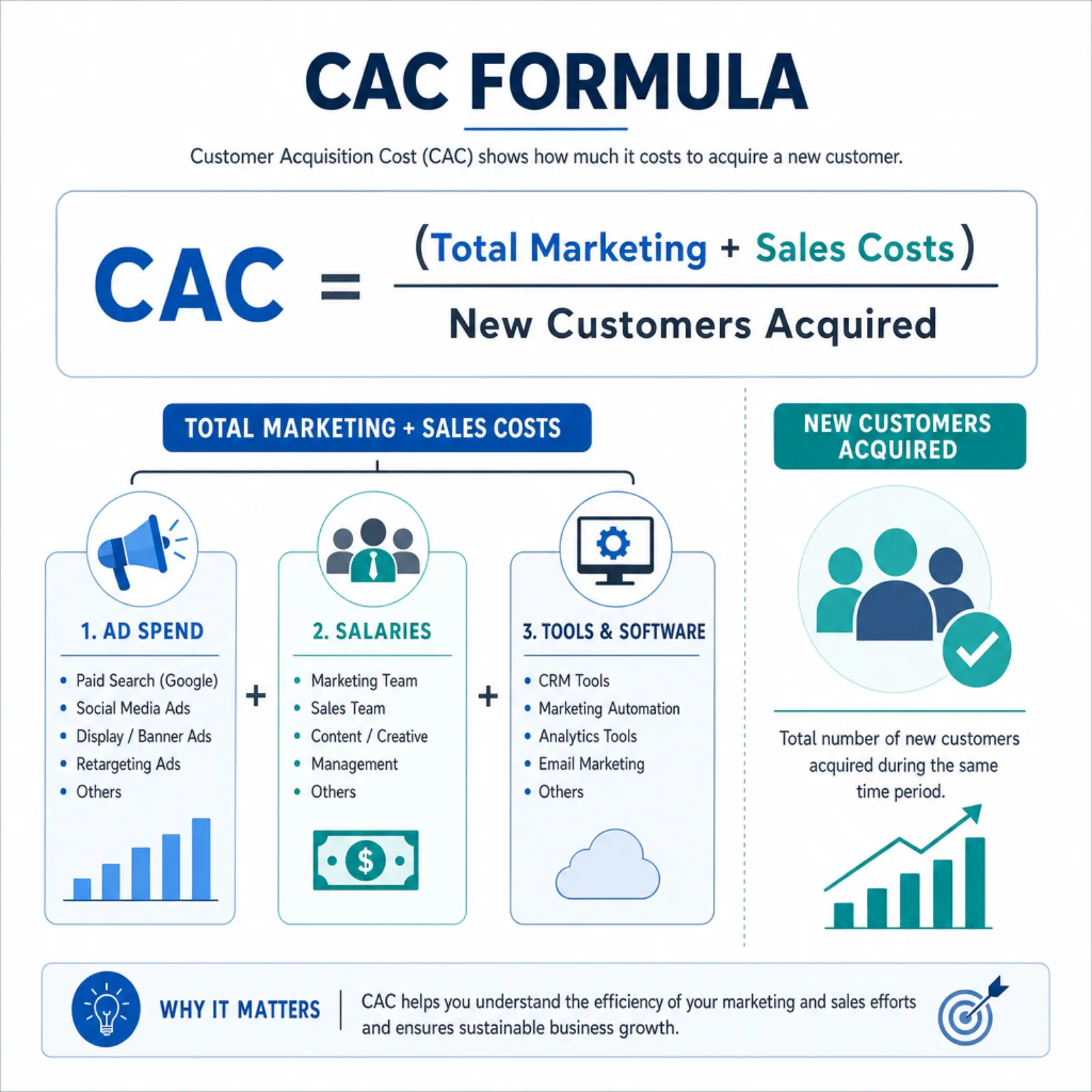
Customer acquisition cost is the total cost of acquiring a new customer. The basic formula is:
CAC = Total Marketing and Sales Spend / Number of New Customers Acquired
For example, if you spent EUR 30,000 on marketing and sales in Q1 and acquired 100 new customers, your CAC is EUR 300.
What to Include in CAC
For an accurate CAC calculation, include all costs involved in acquiring customers:
- Advertising spend: Google Ads, social media ads, display, and any other paid channels
- Marketing team salaries: The portion of time spent on acquisition activities
- Agency fees: Retainers paid to marketing agencies
- Software and tools: CRM, email platform, analytics tools, ad management tools
- Content production: Blog posts, videos, lead magnets, and creative assets
- Sales team costs: Salaries and commissions for sales team members involved in closing new customers
Many businesses undercount by only including ad spend. This gives you a misleadingly low CAC and poor decision-making downstream.
CAC vs. LTV: The Ratio That Matters
CAC alone doesn't tell you whether your acquisition is healthy. The ratio of Customer Lifetime Value (LTV) to CAC is what matters. A commonly cited benchmark is an LTV:CAC ratio of 3:1, meaning each customer generates three times more revenue over their lifetime than it costs to acquire them. Below 3:1, you're spending too much on acquisition relative to what customers are worth. Above 5:1 may mean you're underinvesting in growth.
CAC Benchmarks by Industry
CAC varies dramatically by industry, business model, and sales cycle. These benchmarks provide a reference point, but your target CAC should ultimately be based on your own LTV and margins.
- E-commerce: EUR 30-150 per customer. Lower for impulse purchases, higher for considered purchases.
- SaaS (SMB): EUR 200-500 per customer. Varies significantly by price point and sales model (self-serve vs. sales-led).
- SaaS (Enterprise): EUR 5,000-20,000+ per customer. Long sales cycles with multiple touchpoints justify higher CAC when LTV is proportionally high.
- Professional services: EUR 500-3,000 per client. Depends on contract value and retention rates.
- B2B (general): EUR 300-2,000 per customer. Varies based on deal size and complexity.
- Consumer apps: EUR 1-10 for free installs, EUR 20-100 for paying subscribers.
If your CAC is above these ranges, that's not necessarily a problem as long as your LTV supports it. If your LTV:CAC ratio is below 3:1, it's time to focus on reducing acquisition costs.
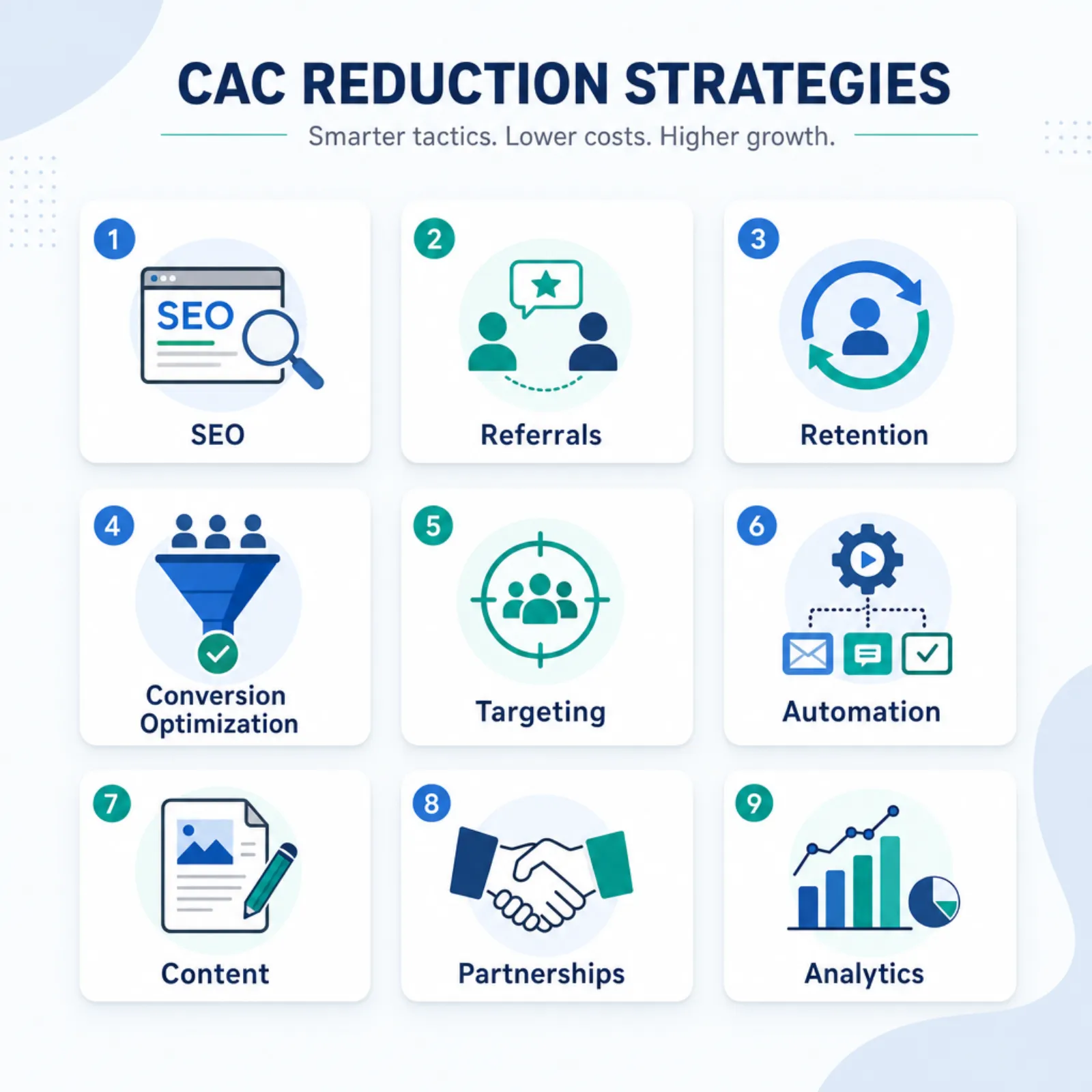
9 Strategies to Reduce Customer Acquisition Cost
1. Invest in SEO and Organic Traffic
Paid advertising gets more expensive every year. CPCs on Google Ads have increased by an average of 10-15% annually across most industries. SEO, by contrast, compounds over time. A blog post that costs EUR 500 to produce and ranks on the first page of Google can generate traffic and leads for years without incremental cost.
How it lowers CAC:
- Organic traffic is "free" after the initial investment in content and optimization
- SEO-acquired customers often have higher intent because they're actively searching for solutions
- Organic content builds authority and trust, reducing the number of touchpoints needed to convert
What to do:
- Invest in keyword research to find high-intent, achievable keywords in your space
- Create comprehensive content that answers your customers' questions better than competitors
- Optimize technical SEO to ensure Google can crawl and index your site effectively
- Build high-quality backlinks through outreach, partnerships, and creating linkable assets
SEO takes 3-6 months to show results, but once it gains momentum, it becomes the lowest-cost acquisition channel for most businesses.
2. Improve Conversion Rates
You can lower CAC without changing your traffic volume by improving how much of that traffic converts. If you're currently converting 2% of visitors and improve to 3%, you've effectively reduced CAC by a third without spending an additional euro on acquisition.
What to do:
- Run A/B tests on landing pages, CTAs, and forms
- Simplify your conversion process (fewer form fields, clearer CTAs, faster pages)
- Add social proof: testimonials, case studies, client logos, and reviews
- Optimize for mobile (where most traffic comes from)
- Use conversion rate optimization systematically, not as a one-time project
3. Optimize Paid Media Targeting
Most paid media accounts waste 20-40% of budget on irrelevant clicks, poor targeting, or underperforming campaigns. Tightening targeting reduces waste and lowers CAC.
What to do:
- Aggressively manage negative keywords in Google Ads
- Review search terms reports weekly and eliminate irrelevant queries
- Narrow audience targeting in social ads based on actual customer demographics
- Pause campaigns, ad groups, or keywords that consistently underperform
- Shift budget from broad awareness campaigns to high-intent, bottom-of-funnel targeting
4. Fix Your Attribution
If you don't know which channels actually drive conversions, you can't optimize your spend. Broken or simplistic attribution leads to overinvestment in channels that get credit but don't drive results and underinvestment in channels that do.
What to do:
- Set up proper conversion tracking across all channels
- Move beyond last-click attribution to multi-touch models
- Use professional analytics to connect marketing touchpoints to actual revenue
- Implement UTM parameters consistently across all campaigns
- Review attribution data monthly and reallocate budget toward channels with the best true ROI
5. Build Email Nurture Sequences
Not every lead is ready to buy immediately. Without email nurture, you're either ignoring these leads or paying to re-acquire them through ads. Email nurture converts leads you've already paid for, reducing the need for additional acquisition spending.
What to do:
- Create lead magnets (guides, checklists, templates) to capture email addresses from organic traffic
- Build automated email sequences that educate, build trust, and move leads toward a purchase decision
- Segment your email list by behavior and interest so every message is relevant
- Re-engage cold leads with win-back campaigns before writing them off
Email marketing typically returns EUR 30-40 for every EUR 1 spent, making it one of the most efficient channels for reducing overall CAC.
6. Reduce Churn
Reducing churn doesn't appear to affect acquisition cost directly, but it has a powerful indirect effect. When you retain customers longer, their LTV increases, which improves your LTV:CAC ratio. This means you can afford a higher CAC while still maintaining healthy unit economics, or you can reduce spend knowing each customer is worth more.
What to do:
- Identify why customers leave through exit surveys and usage analytics
- Implement onboarding sequences that ensure customers realize value quickly
- Build loyalty programs or incentives for long-term customers
- Proactively reach out to at-risk customers before they churn
7. Leverage Content Marketing Across the Funnel
Content marketing reduces CAC by replacing paid touchpoints with organic ones. Instead of paying for every impression and click, you create assets that attract, educate, and convert prospects without incremental media spend.
What to do:
- Create top-of-funnel content that attracts organic search traffic (how-to guides, industry analysis)
- Develop middle-of-funnel content that builds trust (case studies, comparison pages, expert guides)
- Build bottom-of-funnel content that drives conversions (product pages, pricing pages, testimonials)
- Repurpose content across channels: turn a blog post into social posts, an email series, and a video
- Work with a content strategy team to align content with your customer journey
8. Optimize Your Sales Process
If your sales team takes 30 days to follow up on a lead, your CAC reflects that inefficiency. Sales process optimization reduces the cost of converting leads into customers.
What to do:
- Implement lead scoring to prioritize high-intent prospects
- Reduce response time for inbound leads (every hour of delay reduces conversion probability)
- Create sales enablement materials that help close deals faster
- Automate follow-ups and reminders so no lead falls through the cracks
- Align marketing and sales on what constitutes a "qualified lead" to reduce wasted sales effort
9. Consolidate With a Full-Service Agency
Many businesses work with multiple freelancers and niche agencies: one for SEO, another for PPC, a third for email, and someone else for analytics. This fragmented approach creates coordination overhead, duplicated reporting, and misaligned strategies, all of which inflate CAC.
How consolidation lowers CAC:
- A single team with full visibility across channels can identify and fix attribution gaps
- Cross-channel strategy ensures budget flows to the highest-performing channels regardless of channel silos
- Shared reporting and analytics reduce overhead costs
- Consistent messaging across channels improves conversion rates throughout the funnel
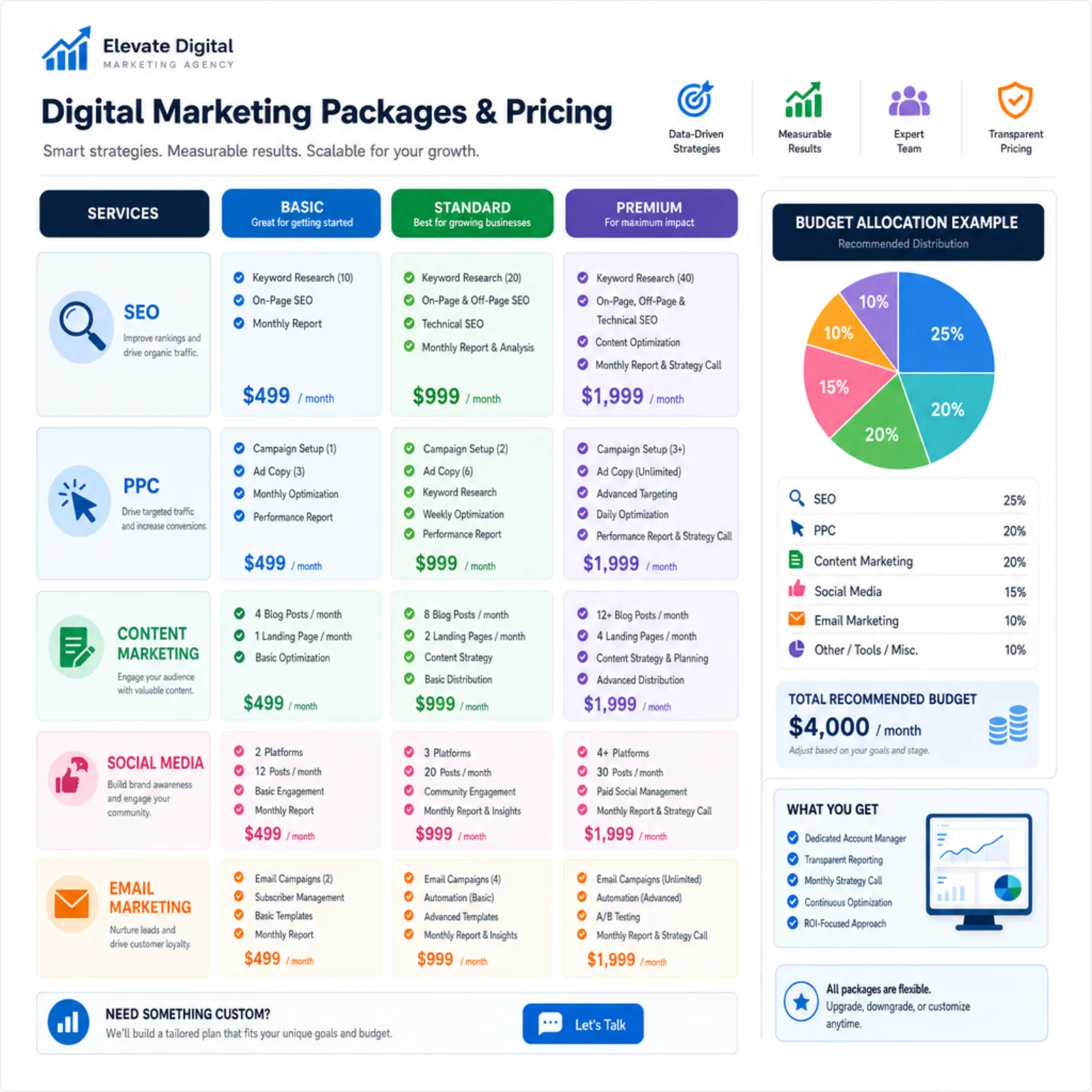
Working with a full-service partner like Atastic means one team managing SEO, paid media, email, content, analytics, and CRO together. This integrated approach typically delivers a lower blended CAC than managing each channel independently. See our pricing for transparent information about what this costs.
How to Measure Whether Your CAC Reduction Is Working
Reducing CAC is not a one-time project. It's an ongoing discipline. Track these metrics monthly to measure progress:
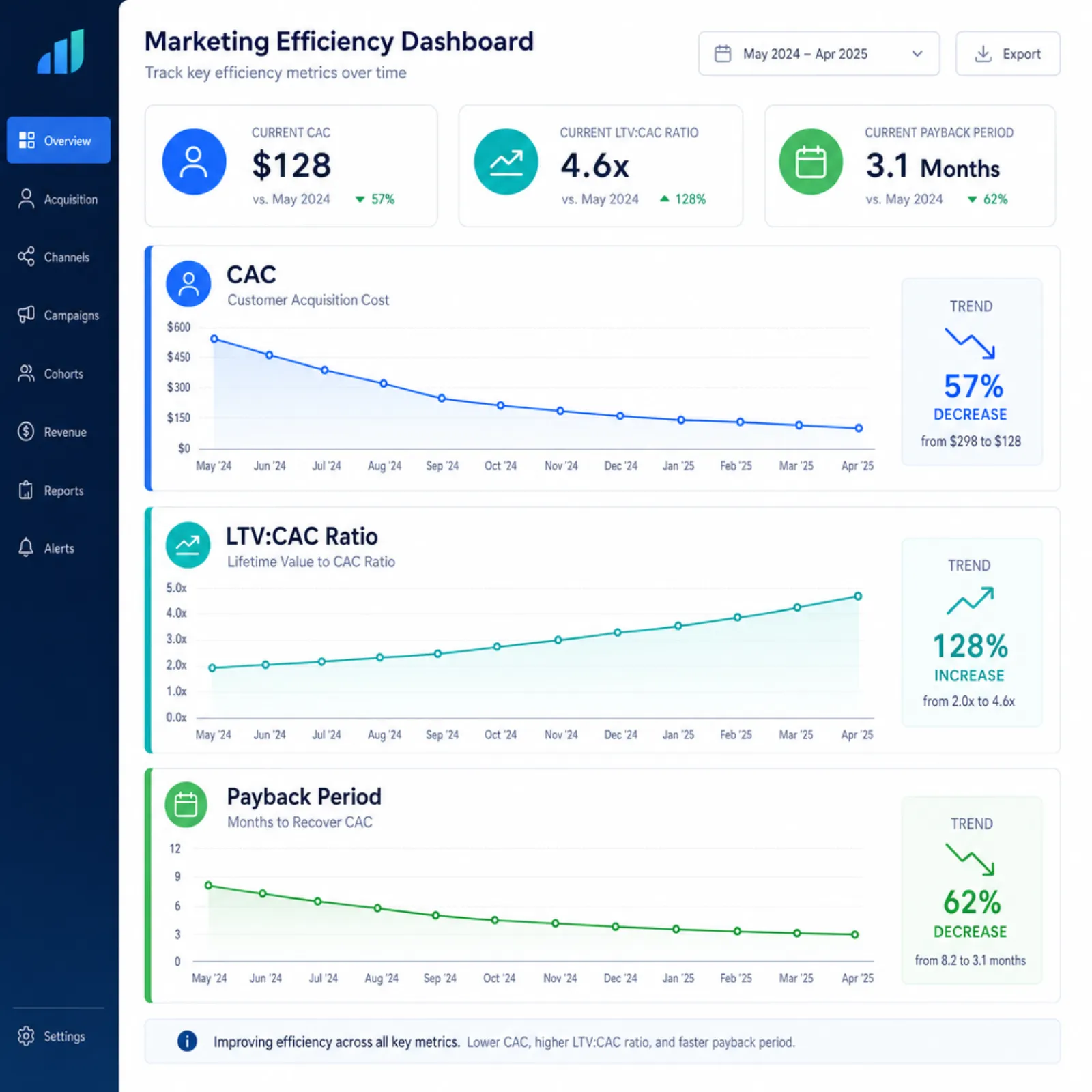
- Blended CAC: Total marketing and sales spend divided by new customers. This is your overall benchmark.
- Channel-level CAC: Break out CAC by channel (organic, paid search, social, email, referral) to see where improvements are happening.
- CAC payback period: How many months it takes for a new customer's revenue to cover their acquisition cost. Lower is better.
- LTV:CAC ratio: Track this monthly. The trend matters more than any single month's number.
- Conversion rate by channel: If your conversion rates are improving, your CAC should be falling (assuming traffic quality is stable).
- Marketing efficiency ratio (MER): Total revenue divided by total marketing spend. This gives you a macro view of marketing efficiency.
Set up a dashboard that tracks these metrics over time. Month-to-month fluctuations are normal, but the 3-month trend should be moving in the right direction.
When to Get Expert Help Reducing CAC
Some CAC challenges are straightforward to address internally. Others require specialized expertise. Consider working with a marketing partner when:
- CAC is trending upward and you can't identify why. An outside perspective often spots inefficiencies that internal teams have become blind to.
- You're spending more than EUR 10,000/month on marketing. At this spend level, a 20% CAC reduction saves EUR 2,000+ every month. The ROI on expert help is usually immediate.
- You lack analytics infrastructure. If you can't accurately calculate CAC by channel, you're optimizing blind. A professional analytics setup is the foundation for every other improvement.
- You need cross-channel optimization. Reducing CAC often requires coordinating changes across SEO, paid media, email, and conversion optimization simultaneously.
- You're preparing to scale. If you plan to double or triple marketing spend, getting your CAC under control first ensures that growth is profitable.
At Atastic, we help businesses reduce customer acquisition costs by optimizing the entire marketing funnel, from top-of-funnel organic traffic through conversion optimization and customer retention. Get in touch to discuss your current CAC and where we see the biggest opportunities for improvement.