How to Track Marketing ROI: Methods, Tools, and Attribution Models That Actually Work
Learn how to track marketing ROI across every channel. Covers formulas, attribution models, tool recommendations, and when you need a professional analytics setup.
Atastic Team
Digital Marketing Agency
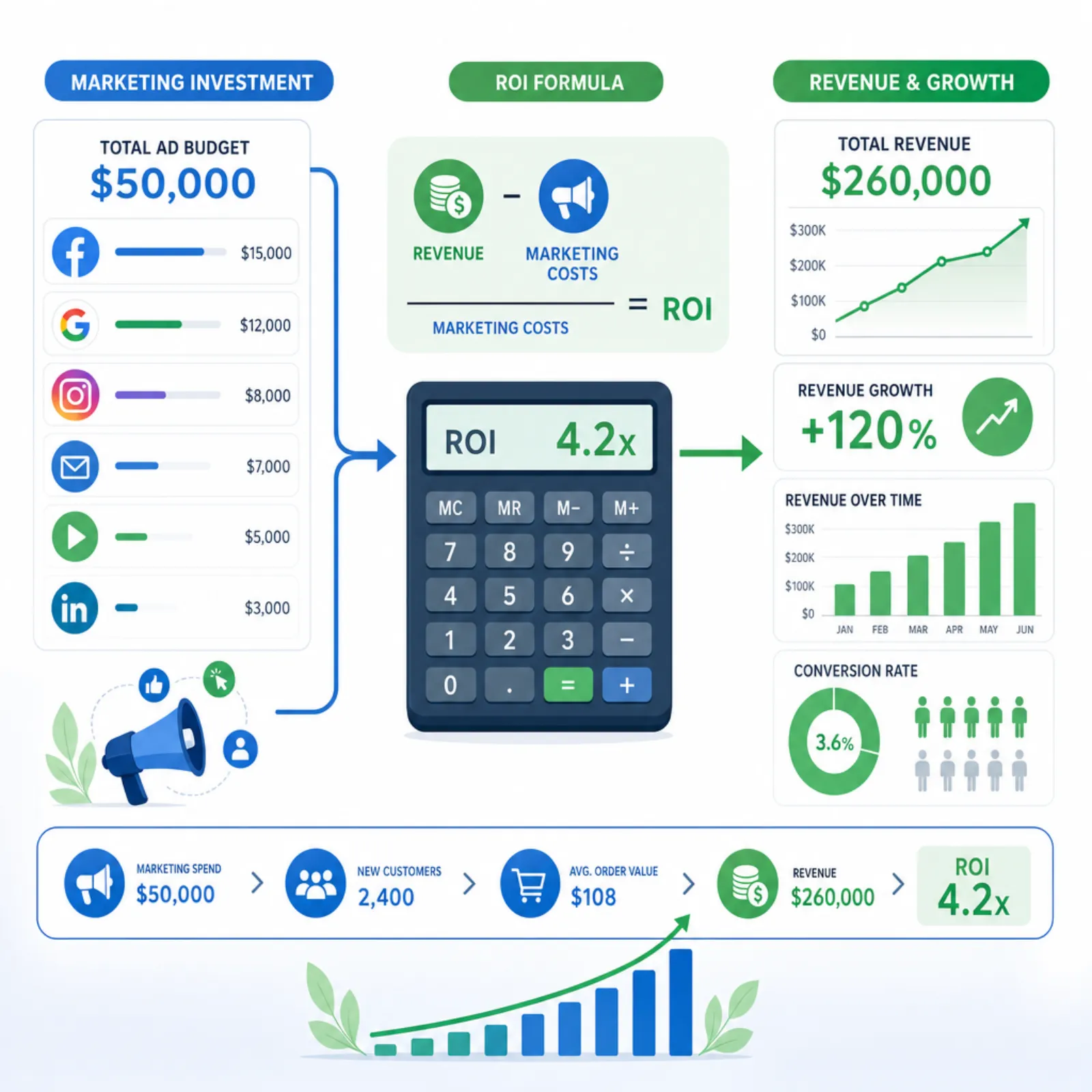
Marketing ROI is the single most important number in your marketing operation. It tells you whether your marketing spend is generating more revenue than it costs. Yet most businesses either don't track it at all or track it incorrectly, leading to misallocated budgets, wasted spend, and missed growth opportunities.
This guide covers how to track marketing ROI properly: the formulas, the attribution models, the tools, and the channel-specific approaches that give you an accurate picture of what's working and what isn't.
Why Most Businesses Get Marketing ROI Wrong
Tracking marketing ROI sounds straightforward: calculate what you spent, measure what you earned, and compare the two. In practice, three problems make it far more difficult than it should be.
Problem 1: Attribution Is Messy
A customer might discover your brand through a blog post, click a retargeting ad two weeks later, open three emails over the next month, and finally convert after a Google search. Which channel gets credit for that sale? The answer depends on your attribution model, and different models produce very different ROI calculations for each channel.
Problem 2: Not All Value Is Immediate
Some marketing activities, particularly SEO and content marketing, don't generate returns for months. If you evaluate ROI on a 30-day window, these channels will always look like losers, even though they may be your most profitable investments over a 12-month horizon.
Problem 3: Tracking Infrastructure Is Incomplete
Many businesses lack the technical foundation to track ROI accurately. Missing UTM parameters, broken Google Analytics configurations, disconnected CRM data, and incomplete conversion tracking all create blind spots. If your tracking is broken, your ROI calculations are fiction.
The rest of this guide addresses each of these problems and gives you a practical framework for getting ROI tracking right.
The Marketing ROI Formula
The Basic Formula
The simplest marketing ROI formula is:
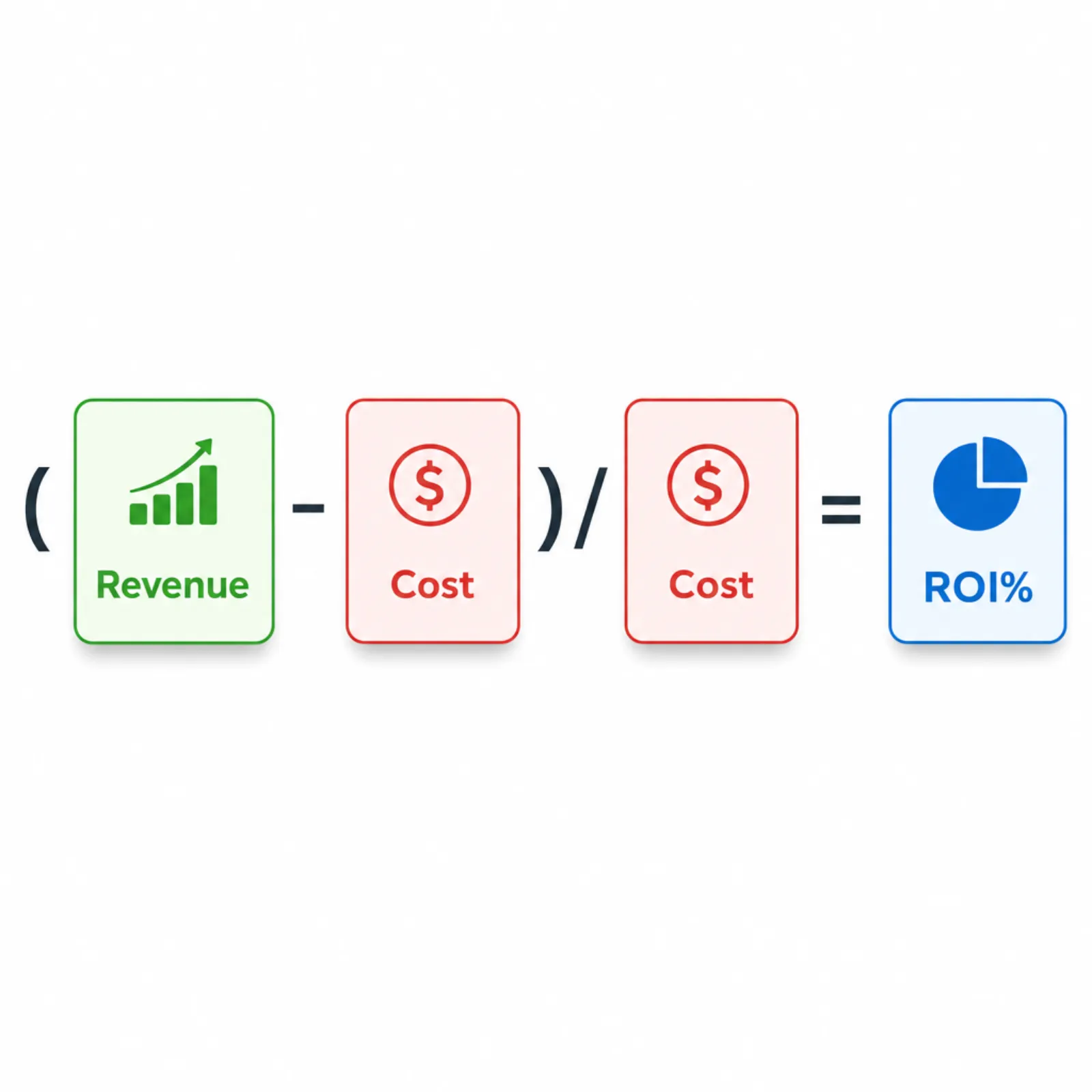
Marketing ROI = (Revenue from Marketing - Marketing Cost) / Marketing Cost x 100
For example, if you spent EUR 10,000 on marketing in a month and generated EUR 50,000 in revenue attributable to marketing, your ROI is:
(50,000 - 10,000) / 10,000 x 100 = 400% ROI
This formula works for a quick snapshot, but it has limitations. It doesn't account for customer lifetime value, product costs, or the time it takes for marketing to generate returns.
The Advanced Formula With LTV
For a more accurate picture, incorporate customer lifetime value (LTV):
Marketing ROI = (Customer LTV x New Customers from Marketing - Marketing Cost) / Marketing Cost x 100
If your average customer LTV is EUR 5,000, you acquired 20 new customers from a EUR 15,000 campaign, your ROI is:
(5,000 x 20 - 15,000) / 15,000 x 100 = 567% ROI
This formula is especially important for businesses with recurring revenue (SaaS, subscription services, retainers) where the initial sale significantly understates the true value of a new customer.
Calculating Marketing Cost
Be thorough when calculating marketing costs. Include:
- Media spend: Ad budgets for Google Ads, social media, display, etc.
- Agency fees: Monthly retainers or project fees
- Software and tools: Analytics platforms, email tools, CRM, SEO tools
- Internal labor: Salaries and time for team members working on marketing
- Content production: Photography, video, copywriting, design
Underestimating costs inflates your ROI and leads to bad decisions. Be honest about the total investment.
Attribution Models Explained
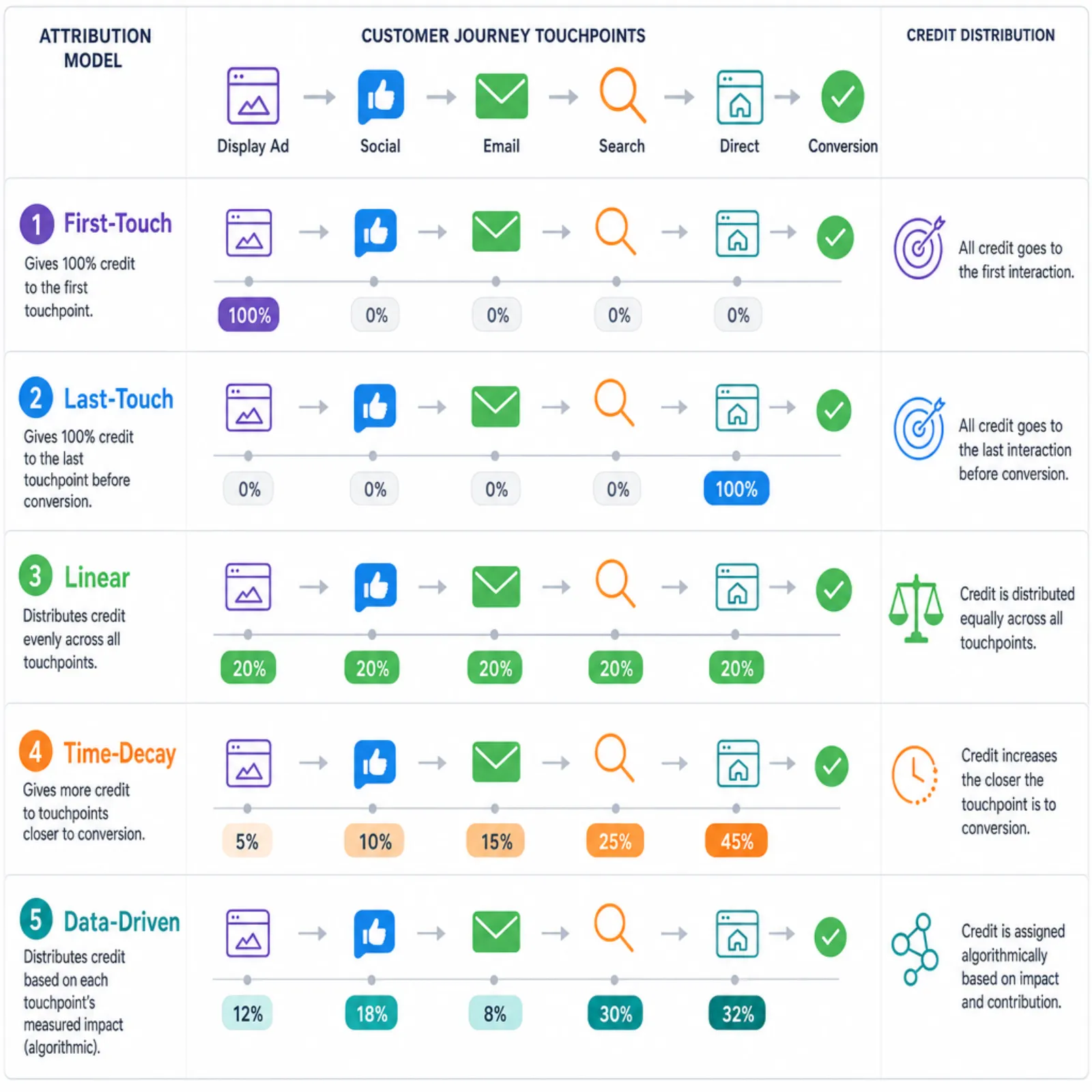
Attribution determines how credit for conversions is assigned to different marketing touchpoints. The model you choose directly impacts how you evaluate each channel's ROI.
Last-Click Attribution
The last touchpoint before conversion gets 100% of the credit. This is the default in many analytics platforms.
Pros: Simple to implement and understand. Clear and unambiguous.
Cons: Overvalues bottom-of-funnel channels (branded search, direct traffic) and undervalues awareness and nurturing channels (content, social, display) that initiated the customer journey.
Best for: Short sales cycles where one touchpoint dominates. E-commerce impulse purchases.
First-Click Attribution
The first touchpoint in the customer journey gets 100% of the credit.
Pros: Highlights which channels drive initial awareness and top-of-funnel demand.
Cons: Ignores the nurturing and closing activities that actually drove the conversion. Overvalues awareness channels.
Best for: Understanding which channels generate new audiences. Useful for brand awareness campaigns.
Linear Attribution
Credit is distributed equally across all touchpoints in the customer journey.
Pros: Acknowledges that every touchpoint contributes. More balanced than single-touch models.
Cons: Treats all interactions as equally important, which is rarely true. A casual blog visit shouldn't carry the same weight as a demo request.
Best for: Organizations new to multi-touch attribution that want a starting point.
Time-Decay Attribution
Touchpoints closer to the conversion receive more credit than earlier touchpoints.
Pros: Reflects the reality that recent interactions are typically more influential in the final decision.
Cons: Still undervalues top-of-funnel activities that created the opportunity in the first place.
Best for: Longer sales cycles where recent engagement signals higher purchase intent.
Data-Driven Attribution
Uses machine learning to analyze your actual conversion data and assign credit based on what actually influences conversions in your specific business. Available in Google Analytics 4 and Google Ads.
Pros: The most accurate model because it's based on your real data, not assumptions.
Cons: Requires significant conversion volume to work effectively (Google recommends at least 300 conversions in 30 days). Can feel like a black box.
Best for: Businesses with enough conversion data and the analytics infrastructure to support it.
Multi-Touch Attribution (MTA)
Custom multi-touch attribution uses a combination of approaches or weighted models tailored to your business. This typically requires dedicated analytics platforms (e.g., HubSpot, Ruler Analytics, or custom-built solutions).
Pros: Can be customized to reflect your actual customer journey and business model.
Cons: Complex to implement and maintain. Requires clean, connected data across all channels.
Best for: Enterprises with complex sales cycles, multiple marketing channels, and dedicated analytics teams.
How to Track ROI by Channel
Each marketing channel has unique tracking requirements and considerations. Here's how to approach ROI measurement for the channels that matter most.
SEO
SEO ROI is challenging to track because the returns are delayed and cumulative. A blog post published today might not rank for 3-6 months but could drive traffic for years.
How to track it:
- Use Google Analytics to filter traffic by organic channel and track conversions from organic visitors
- Assign monetary values to different conversion actions (form fills, downloads, purchases)
- Track organic revenue month-over-month and compare against SEO investment (agency fees, content costs, tools)
- Calculate ROI on a rolling 6-12 month basis to account for the delay in results
Key metrics: Organic traffic growth, organic conversion rate, organic revenue, cost per organic acquisition.
Paid Media
Paid media is the easiest channel to track because ad platforms provide detailed conversion data.
How to track it:
- Ensure conversion tracking is properly set up in each ad platform (Google Ads, Meta Ads, LinkedIn Ads)
- Import offline conversions if your sales process includes phone calls or in-person meetings
- Track Return on Ad Spend (ROAS) = Revenue / Ad Spend
- Calculate true ROI by including agency fees and creative costs alongside ad spend
Key metrics: ROAS, cost per acquisition (CPA), conversion rate by campaign, cost per click (CPC).
Email Marketing
Email marketing typically has the highest ROI of any channel, but only if you track it correctly.
How to track it:
- Use UTM parameters on every link in every email to attribute traffic and conversions to specific campaigns
- Track revenue per email sent and revenue per subscriber
- Segment ROI by email type: newsletters, promotional campaigns, automated sequences, and transactional emails
- Include platform costs and labor in your cost calculation
Key metrics: Revenue per email, revenue per subscriber, conversion rate by campaign type, list growth vs. unsubscribe rate.
Social Media
Social media ROI is notoriously difficult to measure because much of its value is indirect (brand awareness, community building, customer loyalty).
How to track it:
- Use UTM parameters on all social links to track traffic and conversions in Google Analytics
- Track direct conversions from social traffic (last-click) as a baseline
- Monitor assisted conversions in GA4 to see how social contributes to multi-touch journeys
- For organic social, factor in content creation costs and community management time
- For paid social, track ROAS within the ad platform and cross-reference with GA4
Key metrics: Social referral traffic, social conversions (direct and assisted), cost per social conversion, engagement rate.
Content Marketing
Content marketing ROI follows a similar delayed pattern to SEO, since much of your content drives organic traffic.
How to track it:
- Track organic traffic and conversions generated by each piece of content
- Calculate cost per piece (writing, design, promotion) and measure against revenue generated over time
- Monitor content-assisted conversions to see how content contributes to journeys that convert through other channels
- Measure lead magnet performance: downloads, conversion to qualified lead, conversion to customer
Key metrics: Traffic per piece, conversions per piece, cost per content-driven lead, content-influenced revenue.
Tools for Tracking Marketing ROI
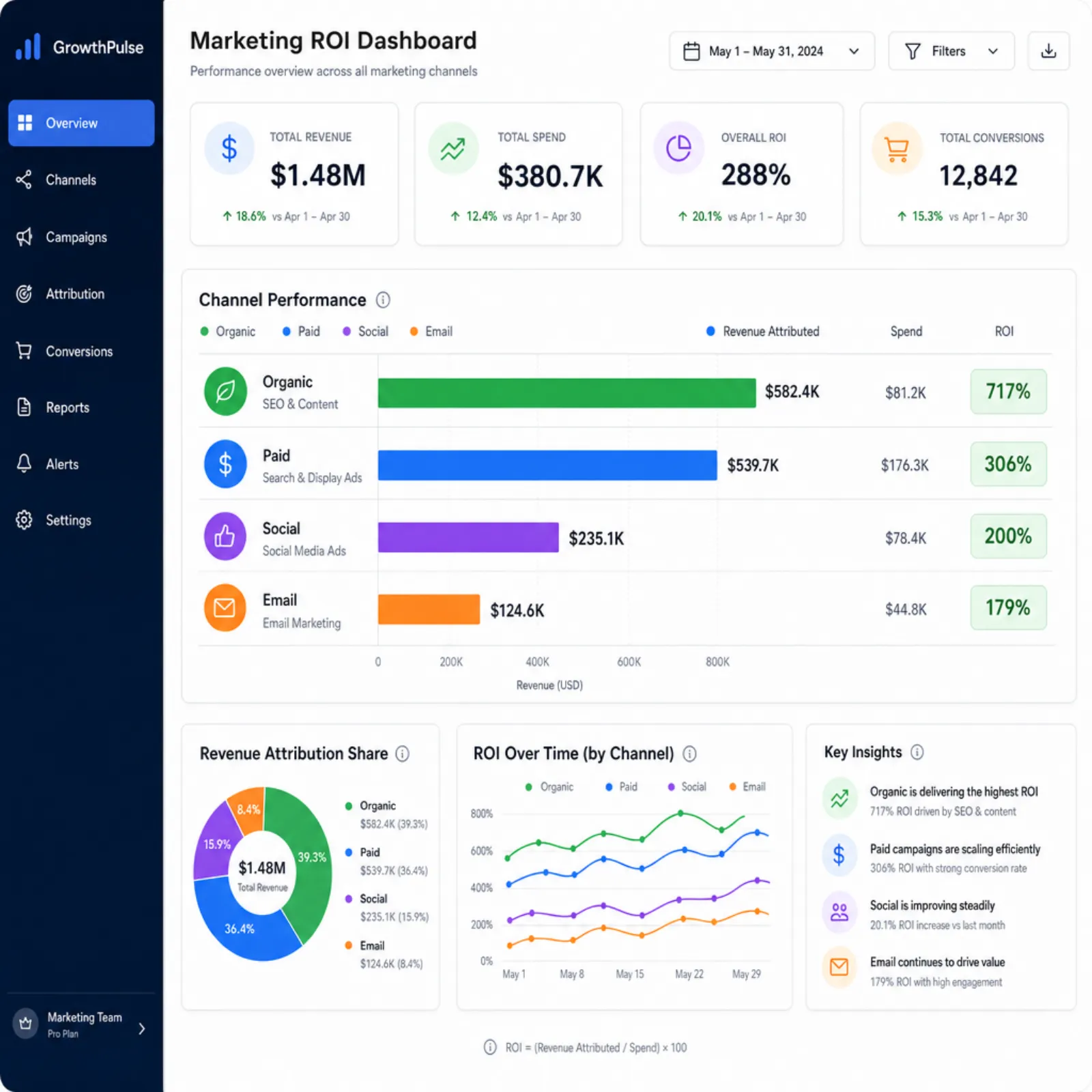
The right tools make ROI tracking significantly easier. Here's what you need at each level.
Essential (Every Business)
- Google Analytics 4: Free, powerful, and the foundation of digital marketing measurement. Tracks traffic, conversions, and user journeys across channels.
- Google Search Console: Free. Tracks organic search performance, keyword rankings, and technical SEO health.
- Google Tag Manager: Free. Manages all tracking tags without requiring developer resources for every change.
- UTM Builder: Consistent UTM parameters are essential for accurate channel attribution. Use a shared UTM template across your team.
Intermediate (Growing Businesses)
- CRM with marketing attribution: HubSpot, Salesforce, or Pipedrive to connect marketing touchpoints to actual revenue. Closes the loop between marketing and sales.
- Email marketing platform with analytics: Mailchimp, Klaviyo, or ActiveCampaign for email-specific ROI tracking.
- Call tracking: CallRail or similar to attribute phone calls to specific marketing channels and campaigns.
Advanced (Larger Budgets, Complex Funnels)
- Multi-touch attribution platforms: Ruler Analytics, Dreamdata, or Northbeam for cross-channel attribution modeling.
- Business intelligence dashboards: Looker Studio, Tableau, or Power BI for custom ROI reporting across all channels.
- Data warehouse: BigQuery or Snowflake to centralize data from all marketing platforms for unified analysis.
When You Need Professional Analytics Help
DIY ROI tracking works at small scale, but as your marketing operation grows, the complexity of accurate measurement grows exponentially. Consider getting professional analytics help when:
- You don't trust your numbers. If different team members, platforms, and reports show different ROI figures, your tracking infrastructure needs an overhaul.
- You can't connect marketing to revenue. Knowing you got 500 leads last month is useful. Knowing which channels produced those leads and which ones became paying customers is essential.
- You're making budget decisions without data. If your budget allocation is based on gut feeling or "what we did last year," you're leaving money on the table.
- You're scaling spend. Going from EUR 5,000/month to EUR 50,000/month in marketing spend demands a robust measurement framework. The cost of getting this wrong increases with every euro you spend.
- You need cross-channel visibility. If your marketing spans SEO, paid media, email, and social, you need a unified view to understand how channels work together.
At Atastic, we set up comprehensive analytics and attribution systems that give businesses clear visibility into what's driving results. Our team handles everything from GA4 configuration and conversion tracking to custom dashboards and attribution modeling.
Contact us to discuss how we can help you track marketing ROI with confidence.