In-House Marketing vs. Agency: How to Choose the Right Model for Your Business
Should you build an in-house marketing team or hire an agency? Compare costs, capabilities, speed, and control to find the right model for your business stage and goals.
Atastic Team
Digital Marketing Agency
Every growing business reaches a point where marketing can no longer be handled by the founder or a single generalist. You need more capacity, more expertise, or both. The question becomes: should you hire an in-house marketing team or partner with an agency?
There is no universally correct answer. The right model depends on your business stage, budget, goals, and how quickly you need to move. This guide lays out the real trade-offs so you can make an informed decision rather than defaulting to one model because it feels familiar.
The Core Trade-Offs
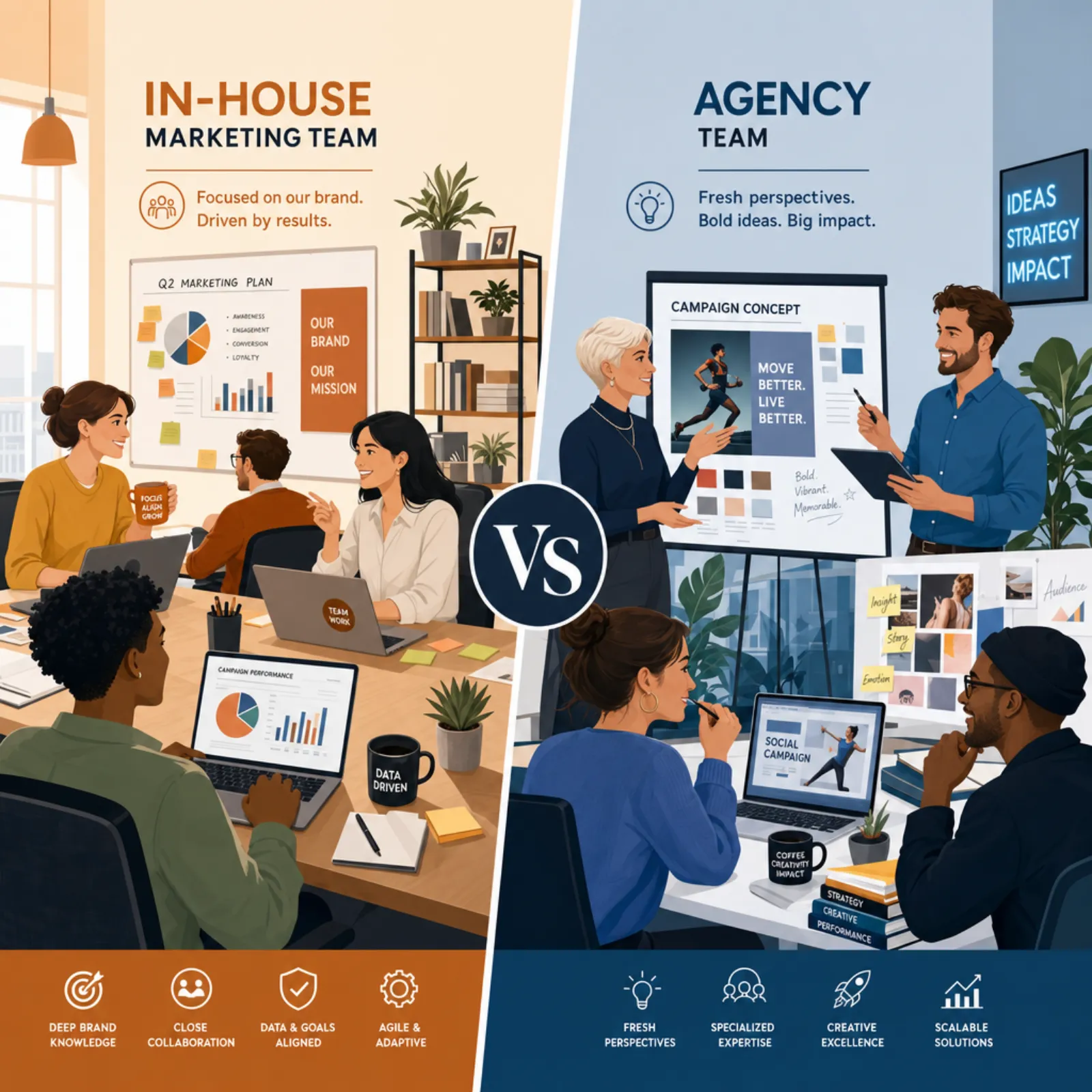
Before diving into the details, here are the five dimensions that matter most when comparing in-house marketing to agency partnerships:
- Cost: In-house teams have higher fixed costs (salaries, benefits, tools). Agencies have variable costs that scale with scope.
- Control: In-house gives you direct oversight and faster day-to-day communication. Agencies require structured collaboration.
- Expertise: Agencies bring deep specialization across multiple disciplines. In-house teams develop deep brand knowledge but may lack breadth.
- Speed: Agencies can often ramp up faster because they already have the people, processes, and tools in place.
- Scalability: Agencies scale up or down with your needs. In-house teams require hiring and onboarding to scale, and layoffs to scale back.
Each of these trade-offs carries different weight depending on your situation. A venture-backed startup that needs to move fast has different priorities than an established mid-market company optimizing for efficiency.
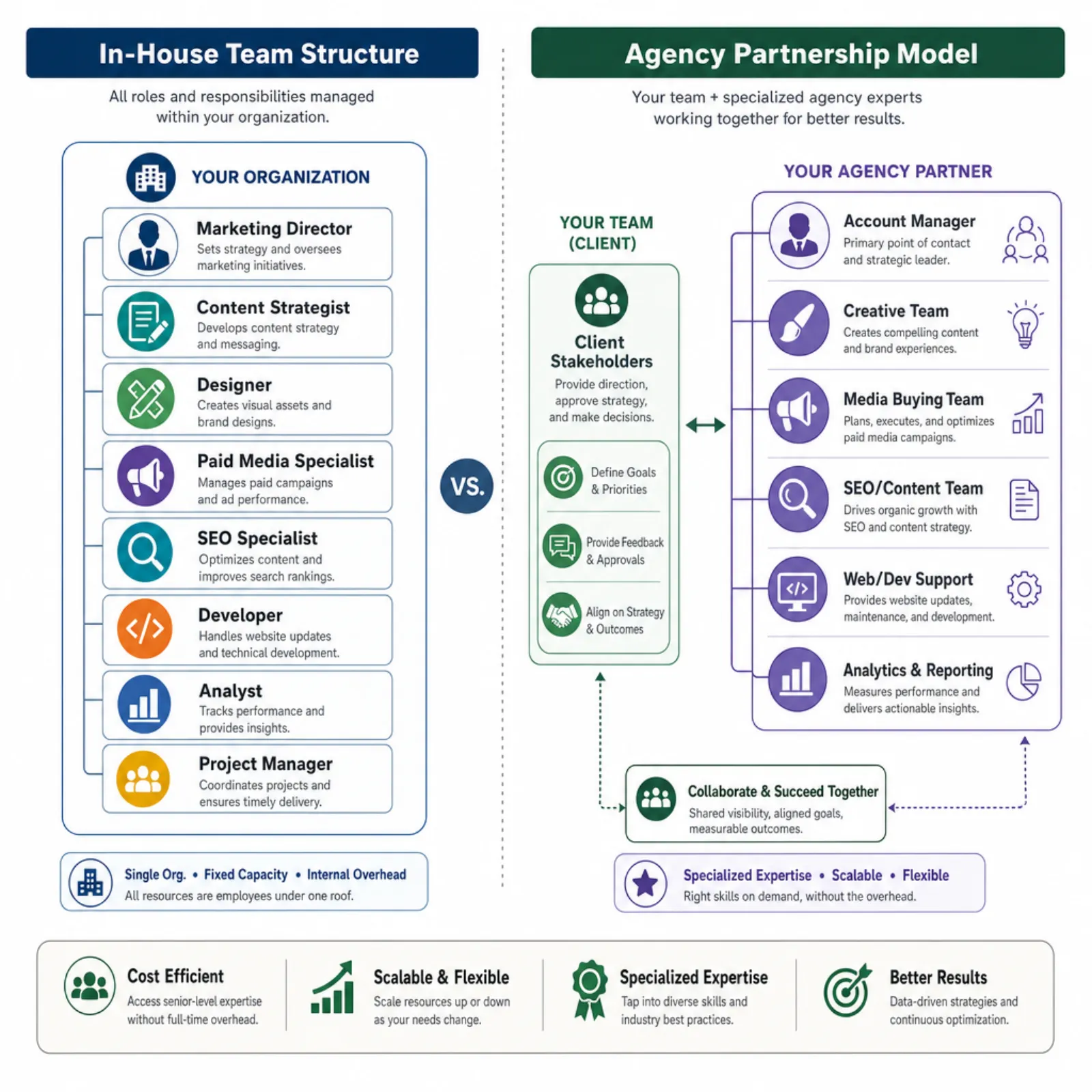
What In-House Marketing Looks Like
Building an in-house marketing team means hiring full-time employees to handle your marketing activities. The structure varies by company size and ambition.
Typical Team Structure
A functional in-house marketing team for a mid-size company often includes:
- Marketing Manager or Director: Owns strategy and coordinates execution
- Content Writer or Strategist: Produces blog posts, landing pages, and editorial content
- SEO Specialist: Manages technical SEO, keyword strategy, and organic growth
- Paid Media Specialist: Runs Google Ads, social ads, and other paid campaigns
- Designer: Creates visual assets for campaigns, social media, and the website
- Social Media Manager: Handles daily posting, community management, and social strategy
Smaller companies usually start with a marketing generalist or manager and add specialists as the team grows. Larger organizations add roles like marketing operations, email marketing, analytics, and brand management.
Realistic Costs
In-house marketing teams are a significant investment. Beyond salaries, you need to account for:
- Salaries: A marketing manager in Western Europe typically earns EUR 55,000 to EUR 85,000. Specialists range from EUR 40,000 to EUR 70,000 each.
- Benefits and overhead: Add 25 to 40 percent on top of salary for benefits, taxes, office space, and equipment
- Tools and software: SEO tools, CRM, analytics platforms, design software, social scheduling tools. Budget EUR 500 to EUR 3,000+ per month.
- Training and development: Marketing evolves rapidly. Budget for conferences, courses, and certifications.
- Management time: Someone needs to manage, mentor, and hold the team accountable
A lean three-person in-house team (manager, content person, specialist) can easily cost EUR 180,000 to EUR 280,000 per year in total loaded cost. A five or six-person team crosses EUR 400,000.
Advantages of In-House
- Deep brand knowledge: Full-time team members live and breathe your brand, products, and customers every day
- Cultural alignment: They are embedded in your company culture and internal communication
- Availability: Dedicated to your business, not splitting attention across multiple clients
- Institutional knowledge: Accumulated learning stays within the company
- Direct control: You manage priorities, timelines, and quality directly
Disadvantages of In-House
- High fixed costs: Salaries are owed regardless of workload or results
- Skill gaps: It is nearly impossible to hire people who are experts in every discipline (SEO, PPC, analytics, content, design, email)
- Recruitment challenges: Hiring strong marketers takes time, and turnover creates disruption
- Limited perspective: An internal team may develop tunnel vision without exposure to other industries and strategies
- Scaling friction: Ramping up requires hiring. Scaling back means letting people go.
What Working with an Agency Looks Like
An agency partnership gives you access to a team of specialists without the overhead of hiring them full-time. The engagement model varies depending on the agency and your needs.
Engagement Models
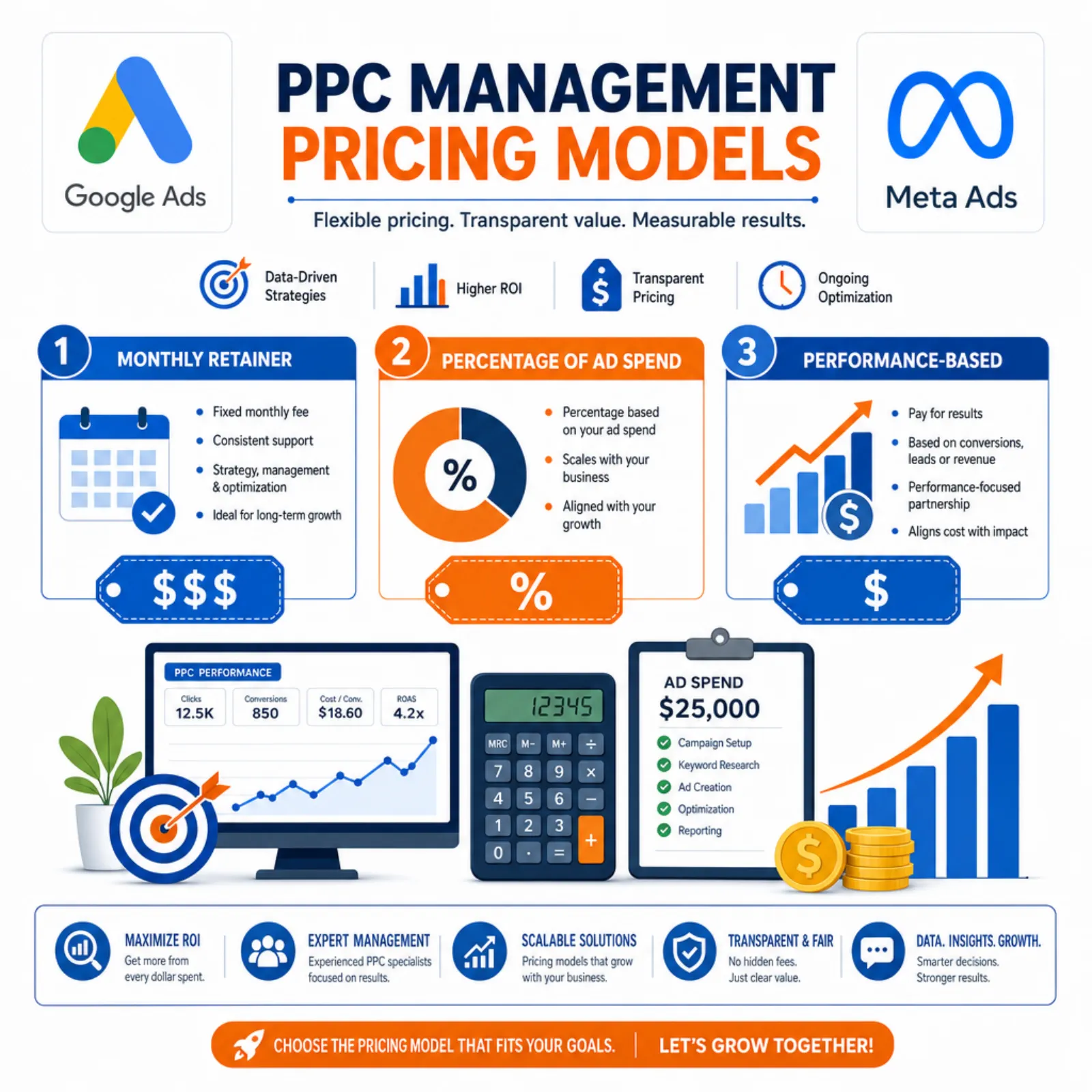
- Monthly retainer: You pay a fixed monthly fee for an agreed scope of work. The agency becomes a consistent extension of your marketing function.
- Project-based: You hire the agency for a specific initiative (website redesign, campaign launch, SEO audit) with defined deliverables and timeline.
- Consulting or advisory: The agency provides strategic guidance and your internal team handles execution.
Realistic Costs
Agency retainers vary widely, but here are realistic ranges for the European market:
- Boutique or specialized agency: EUR 2,000 to EUR 5,000/month
- Mid-size full-service agency: EUR 5,000 to EUR 15,000/month
- Large agency: EUR 15,000 to EUR 50,000+/month
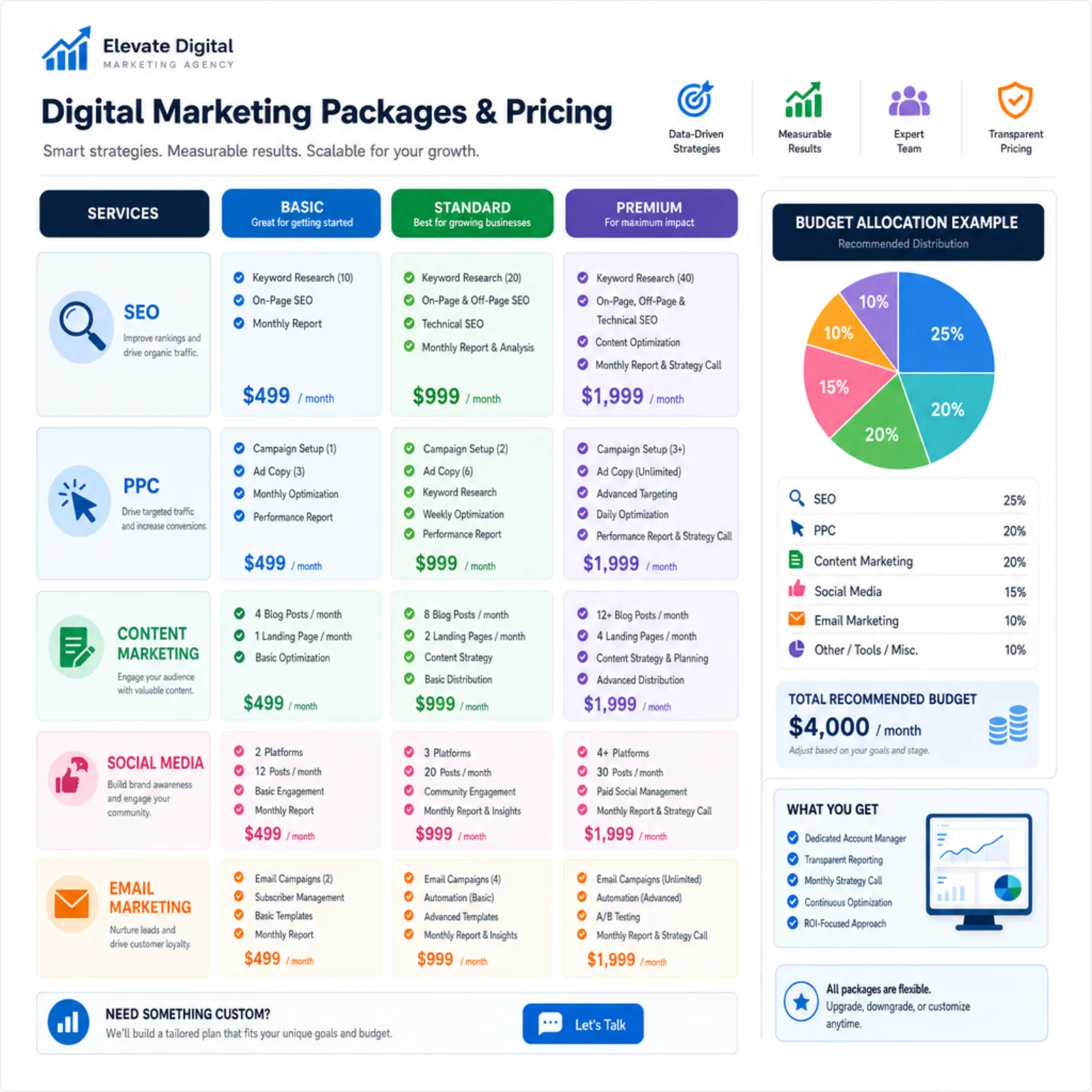
These costs cover a team of specialists (strategist, SEO expert, content writer, designer, project manager) working on your account. The equivalent in-house team would cost significantly more. You can explore our pricing for a transparent look at what agency partnerships cost in practice.
Advantages of an Agency
- Breadth of expertise: Access to specialists across SEO, PPC, content, analytics, design, and more without hiring each one
- Speed to results: Agencies have established processes and can start delivering quickly
- Fresh perspective: Working across multiple clients and industries brings cross-pollinated insights
- Scalability: Increase or decrease scope without hiring or firing
- Lower risk: If the relationship does not work, you change agencies. No severance, no recruiting.
- Tools included: Most agencies include enterprise-grade tools in their retainer fee
Disadvantages of an Agency
- Less control: You cannot walk over to someone's desk and redirect priorities instantly
- Shared attention: Your account competes for time with other clients
- Learning curve: It takes time for an agency to understand your brand, products, and industry deeply
- Communication overhead: Requires structured meetings, briefs, and approval processes
- Dependency risk: If you part ways, institutional knowledge leaves with the agency
Cost Comparison
Let's put real numbers side by side for a mid-size company that needs SEO, content, paid media, and analytics capabilities.
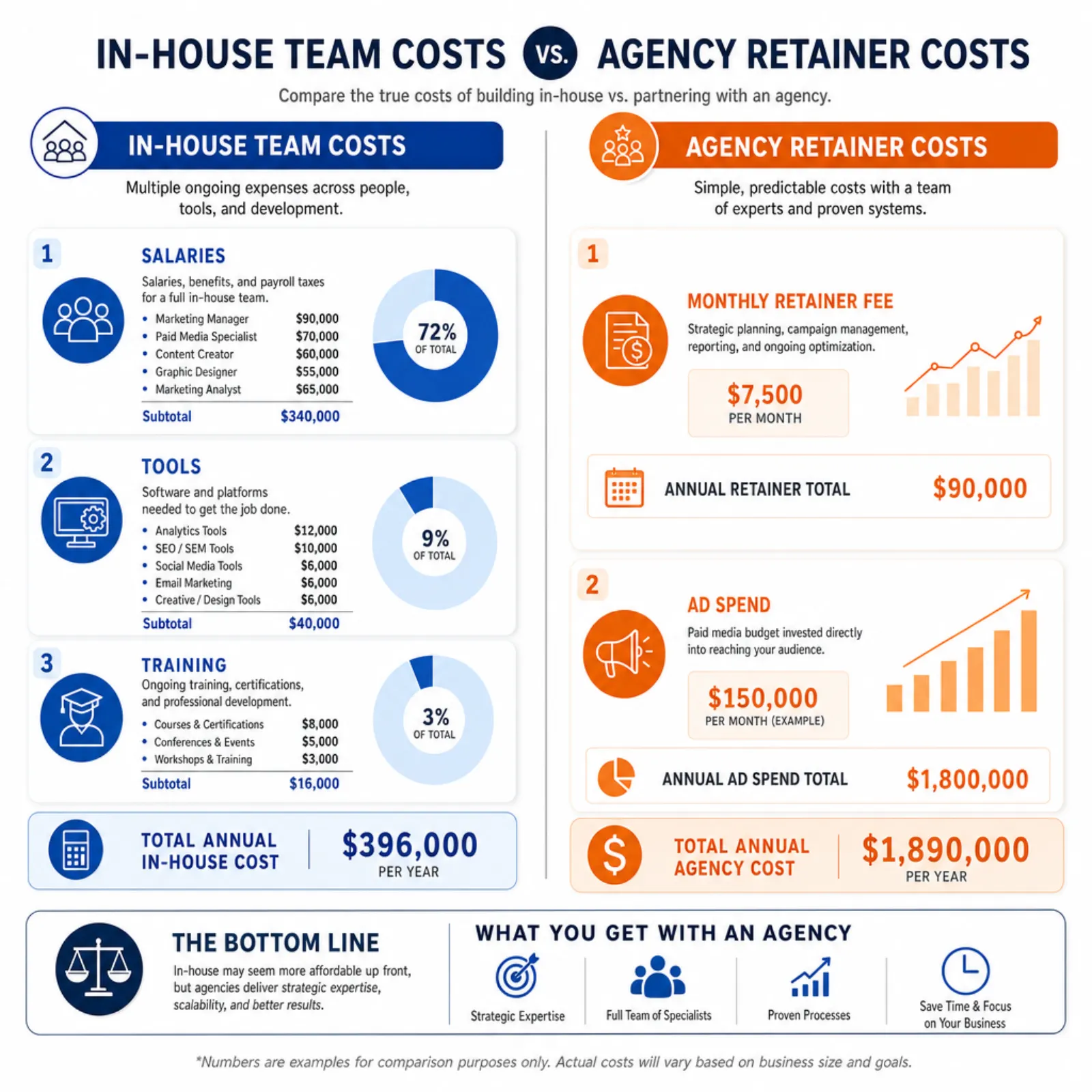
In-House Team (4 people)
- Marketing Manager: EUR 70,000
- SEO/Content Specialist: EUR 55,000
- Paid Media Specialist: EUR 55,000
- Designer (part-time or junior): EUR 35,000
- Benefits and overhead (30%): EUR 64,500
- Tools and software: EUR 18,000/year
- Total annual cost: approximately EUR 297,500
Agency Retainer (equivalent scope)
- Monthly retainer for SEO, content, paid media, and design: EUR 6,000 to EUR 10,000/month
- Annual cost: EUR 72,000 to EUR 120,000
- Ad spend is separate (same in both models)
- Total annual cost: approximately EUR 72,000 to EUR 120,000
The agency option costs roughly 40 to 60 percent less for equivalent capabilities. However, the in-house team offers more hours and deeper brand immersion. The right choice depends on whether you need that level of dedicated capacity or whether agency-level involvement is sufficient.
Choose In-House When...
An in-house team makes more sense in specific situations:
- You need deep, daily brand integration: Companies in highly regulated industries (healthcare, finance) or those with complex products often need marketers who truly understand the business at a deep level
- You have high-volume, ongoing needs: If you need 20+ pieces of content per month, daily social media management, and constant campaign adjustments, the volume may justify full-time hires
- Marketing is a core competency: If marketing is central to your competitive advantage (like a media company or direct-to-consumer brand), owning it in-house gives you speed and control
- You can afford it: Building a competent team requires a budget of EUR 200,000+ per year. If that is within reach and you have leadership to manage the team, in-house can deliver strong results.
- You have strong marketing leadership: An in-house team without an experienced marketing leader tends to produce scattered, unfocused work. If you have a VP of Marketing or CMO who can set strategy and manage execution, the team will thrive.
Choose an Agency When...
An agency partnership is the better fit in these scenarios:
- You need specialized expertise: Hiring a full-time SEO expert, PPC specialist, and analytics engineer is expensive. An agency gives you access to all three and more. Explore the range of services an agency like Atastic provides.
- You need to move fast: Agencies can start delivering within weeks. Hiring takes months.
- Your needs are variable: If marketing demands fluctuate seasonally or by project, an agency scales without the commitment of full-time headcount
- You lack internal marketing leadership: Without someone to manage and direct an in-house team, an agency provides both strategy and execution
- You want to test channels before committing: Use an agency to validate whether SEO, paid media, or content marketing works for your business before hiring specialists
Choose Hybrid When...
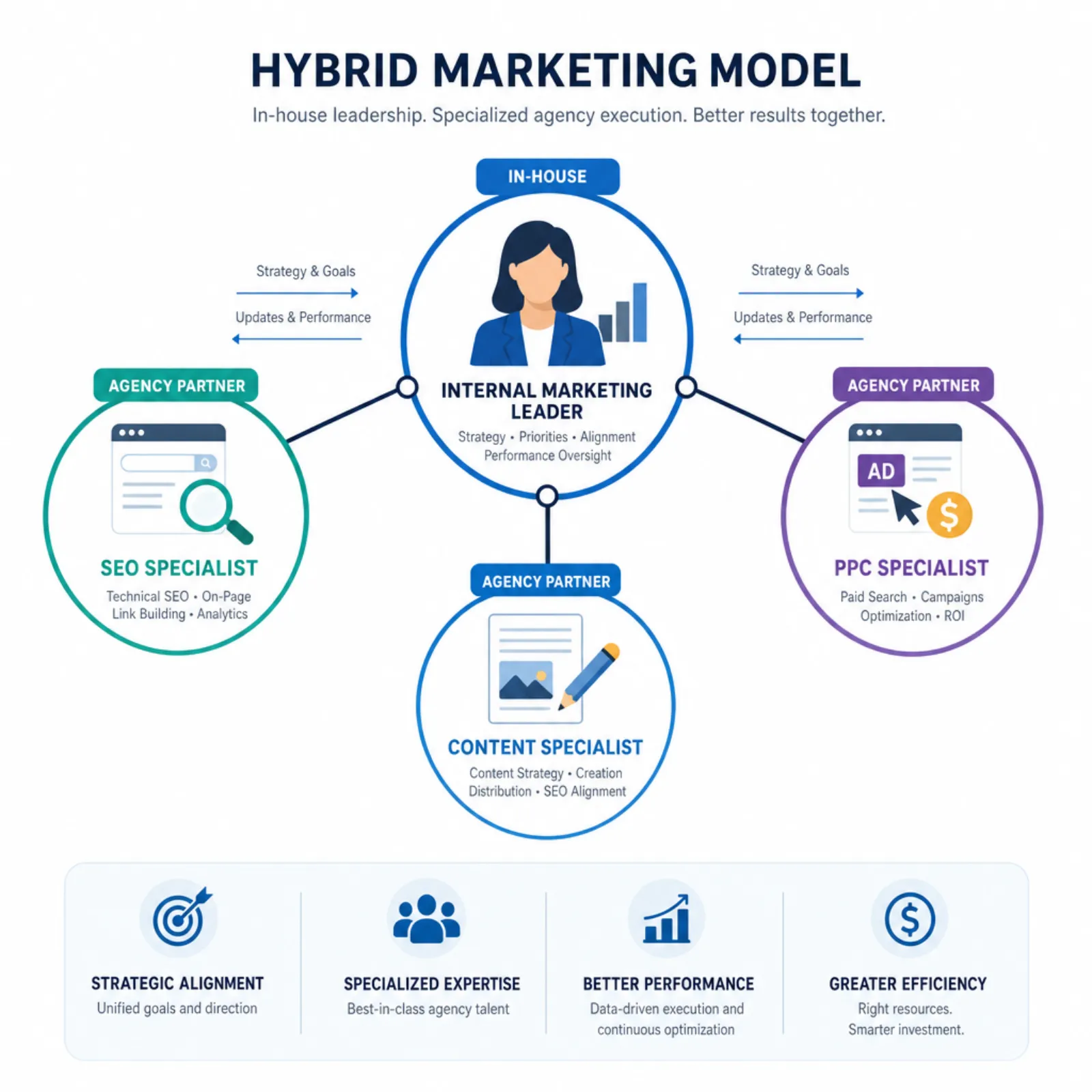
Many successful companies use a hybrid model that combines the strengths of both approaches. This is often the most effective structure for growth-stage businesses.
The typical hybrid setup looks like this:
- In-house: A marketing leader (Head of Marketing, VP Marketing) who owns strategy, brand, and coordinates all marketing activity. Possibly a content person with deep product knowledge.
- Agency: Handles specialized execution across channels like SEO, paid media, and analytics. Brings the tools, processes, and expertise that would be too expensive to build internally.
This model works because:
- Your marketing leader ensures everything aligns with business strategy and brand
- The agency brings depth of expertise across multiple disciplines
- You get the speed and scalability of an agency with the strategic coherence of in-house leadership
- Total cost is lower than building a full in-house team while delivering higher quality than either model alone
Learn more about how the Atastic team works alongside our clients' internal marketing leaders.
How to Make an Agency Partnership Work
If you decide to work with an agency, the quality of the partnership depends on how you structure and manage it. Here is what separates productive agency relationships from frustrating ones.
Set Clear Expectations
Before starting, align on:
- Specific, measurable goals (not "do SEO" but "increase organic traffic by 40% in 12 months")
- Scope of work and deliverables for each month
- Communication cadence (weekly syncs, monthly reports, quarterly strategy reviews)
- Who approves what, and how quickly
- What the agency needs from you (brand guidelines, access, subject matter expertise, timely feedback)
Treat Them as a Partner, Not a Vendor
The best agency relationships are collaborative. Share context about your business, involve them in strategic discussions, and give honest feedback. Agencies that understand your business produce dramatically better work than those kept at arm's length.
Invest in Onboarding
The first 30 to 60 days set the tone. Spend time educating the agency about your products, customers, competitive landscape, and brand voice. This investment pays off in better, more relevant work from day one.
Measure What Matters
Track the agency's impact on business outcomes, not just activity metrics. Are they driving leads? Revenue? Growth in organic visibility? Set up proper analytics tracking so you can attribute results accurately.
Give It Time
SEO and content marketing take months to compound. Paid media can show results faster, but even there, optimization takes time. Evaluate performance at the 90-day and 6-month marks, not after week two.
Communicate Proactively
Tell your agency when priorities shift, when a product launch is coming, or when the CEO has a new strategic direction. The more context they have, the better aligned their work will be.
Making the Decision
There is no one-size-fits-all answer to the in-house vs. agency question. The right model is the one that gives you the best marketing outcomes for your current business stage, budget, and goals.
If you are exploring whether an agency partnership makes sense for your business, reach out to the Atastic team. We are happy to discuss your situation candidly, even if the honest answer is that in-house is the better path for you right now.