Content Marketing for Lead Generation: A Practical Framework
Discover how to use content marketing to generate qualified leads. This framework covers funnel mapping, lead magnets, distribution, and the metrics that matter for measuring content ROI.
Atastic Team
Digital Marketing Agency
Content marketing generates three times more leads than outbound marketing while costing 62% less. But those numbers only hold if you approach content marketing with a lead generation framework, not just publishing blog posts and hoping for the best.
Most businesses produce content without a clear connection to their sales pipeline. The result is traffic that never converts. This guide lays out a practical framework for using content marketing to generate qualified leads consistently.
Why Content Marketing Works for Lead Generation
Content marketing generates leads by solving problems your target audience has before they're ready to buy. When someone finds a helpful blog post, downloads a useful guide, or watches an insightful video from your brand, you've built trust and demonstrated expertise. That trust converts into leads when the prospect is ready to take action.
The content marketing lead generation cycle works like this:
- A prospect searches for a solution to their problem
- They find your content via search, social media, or referral
- Your content answers their question and establishes your credibility
- They engage further: subscribing, downloading, or contacting you
- You nurture the relationship until they're ready to buy
Step 1: Map Content to Your Sales Funnel
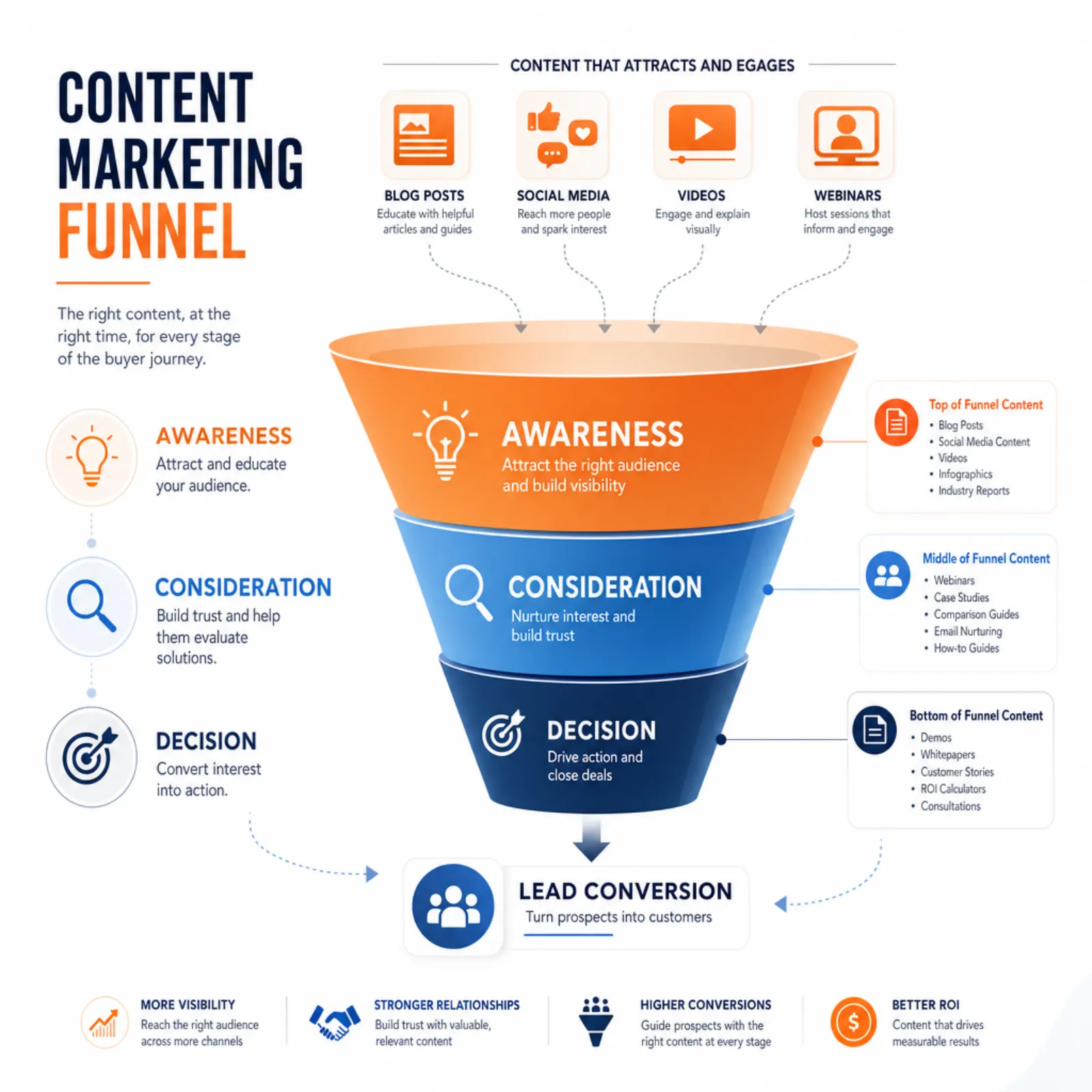
Not all content serves the same purpose. Effective content marketing for lead generation requires content at every stage of the buyer journey.
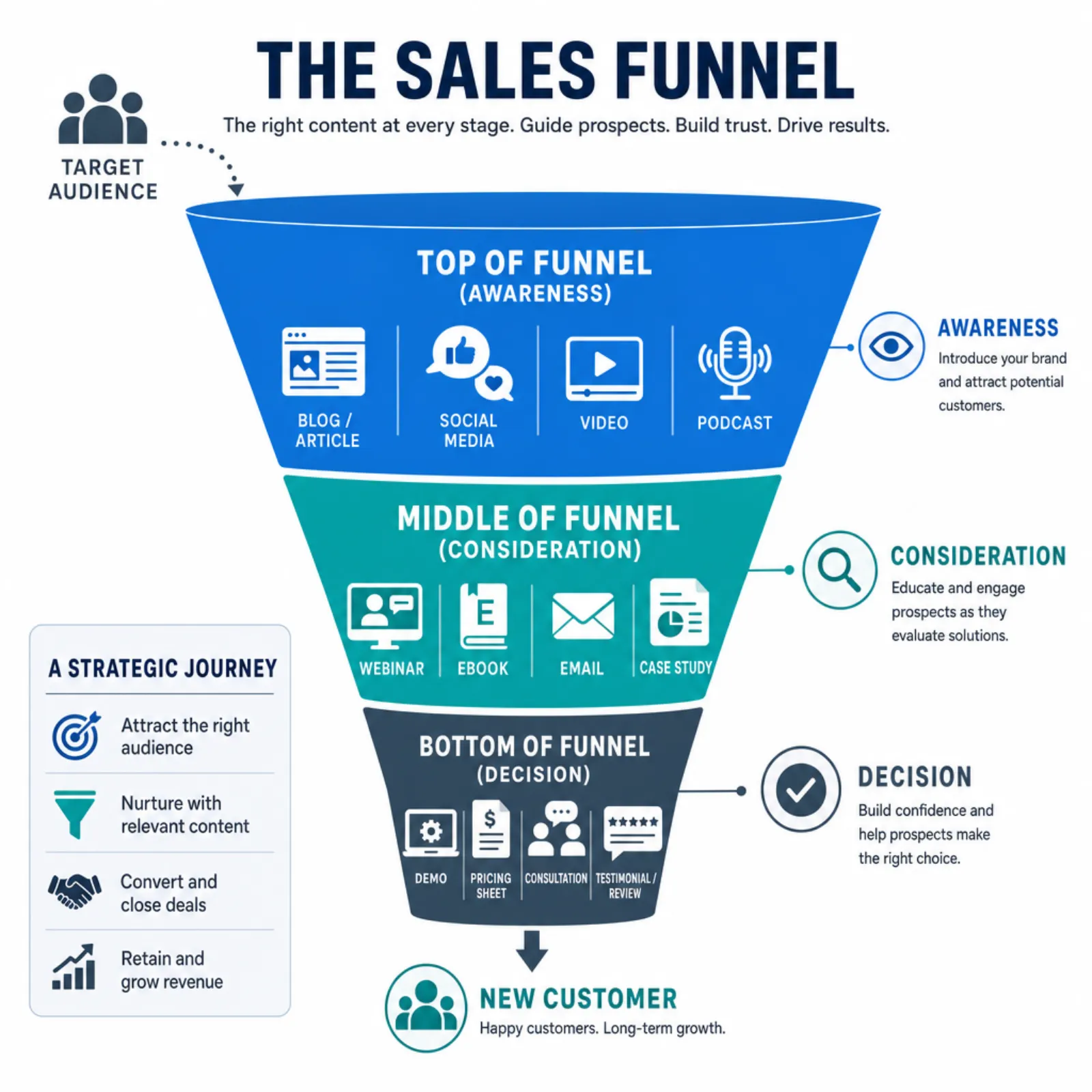
Top of Funnel (Awareness)
Goal: Attract strangers who don't know you yet.
Content types:
- Blog posts targeting informational keywords your audience searches for
- Social media content that educates and entertains
- Videos and podcasts covering industry topics
- Infographics presenting data in shareable formats
This content should rank in search engines and be shareable on social media. It builds your audience but doesn't directly ask for anything in return.
Middle of Funnel (Consideration)
Goal: Convert visitors into known leads.
Content types:
- Lead magnets: Comprehensive guides, templates, checklists, or tools offered in exchange for an email address
- Case studies showing how you've solved similar problems
- Webinars and workshops providing in-depth education
- Comparison content helping prospects evaluate options
This is where lead generation happens. The exchange is simple: valuable content in return for contact information.
Bottom of Funnel (Decision)
Goal: Convert leads into customers.
Content types:
- Product demos and free trials
- Customer testimonials and success stories
- ROI calculators and assessment tools
- Detailed pricing and comparison pages
Step 2: Create High-Converting Lead Magnets
Lead magnets are the engine of content-driven lead generation. A lead magnet is any valuable piece of content offered in exchange for contact information (typically an email address).
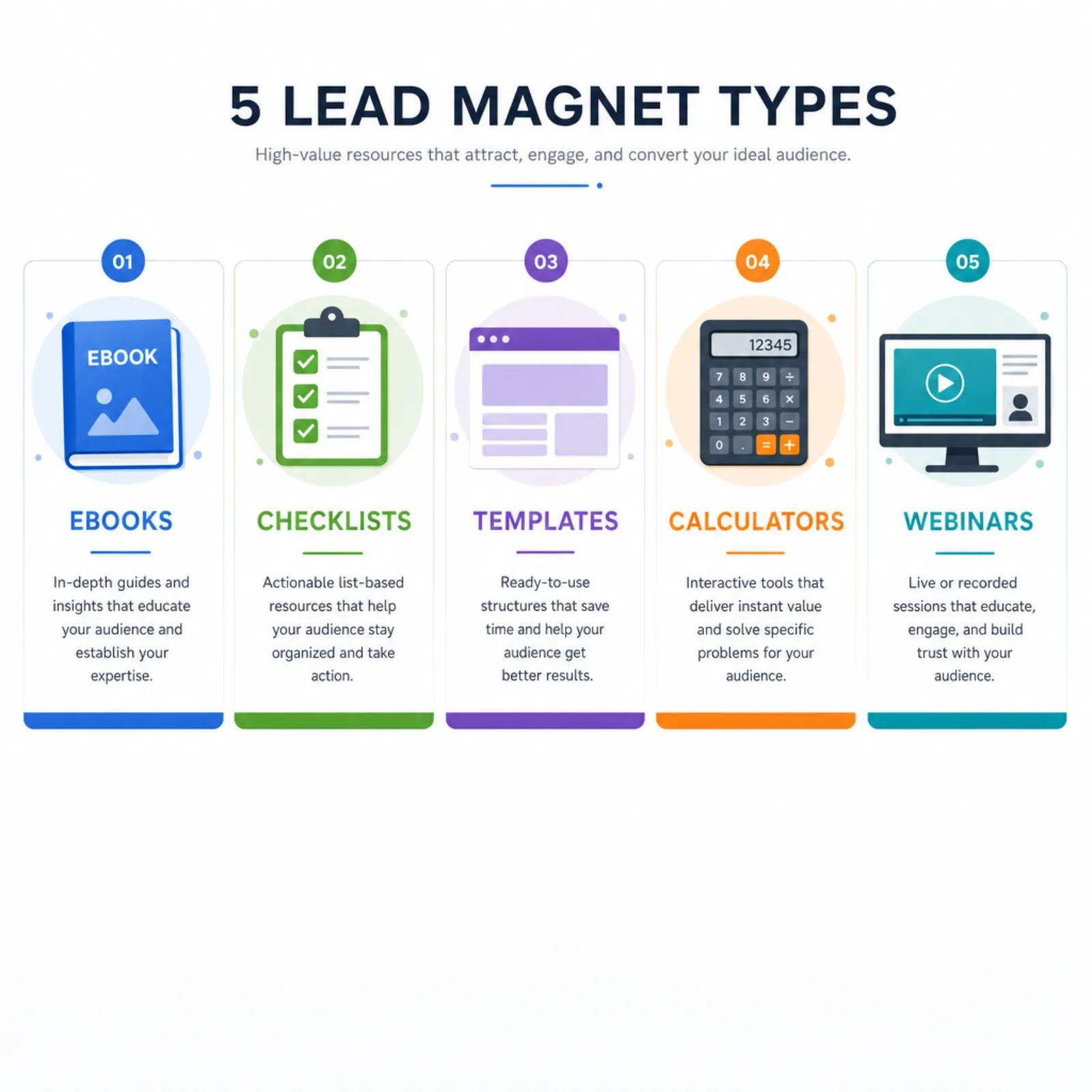
What Makes a Great Lead Magnet
- Specificity: Solves one clear problem rather than being a generic overview
- Immediate value: The reader can apply it right away
- Perceived value: It looks and feels professional
- Relevance: It attracts the same people who would buy your service
Lead Magnet Ideas by Industry
B2B Services: Industry benchmarking report, ROI calculator, audit checklist, strategy template
E-commerce: Buying guide, discount code, style quiz, product comparison chart
SaaS: Free trial, feature comparison spreadsheet, implementation checklist, workflow templates
Agencies: Audit reports, strategy playbooks, case study collections, budget planning templates
Lead Magnet Placement
Don't hide your lead magnets. Place them where they'll get maximum visibility:
- Within blog posts: Contextually relevant to the topic (highest conversion rates)
- Exit-intent popups: Capture visitors before they leave
- Dedicated landing pages: For promoting via ads and email
- Sidebar and footer: Persistent visibility across the site
Step 3: Optimize Content for Search
Organic search is the most scalable distribution channel for content marketing. Content that ranks drives leads on autopilot, month after month.
Keyword Strategy for Lead Generation
Not all keywords are equal for lead generation. Prioritize:
- Problem-aware keywords: "how to improve [thing your service fixes]"
- Solution-aware keywords: "[your service type] for [target audience]"
- Comparison keywords: "[solution A] vs [solution B]"
- Commercial keywords: "best [service/product] for [use case]"
Informational keywords with high search volume build your audience. Commercial keywords with buying intent drive direct conversions. You need both. For a detailed approach, read our guide on building a digital marketing strategy.
On-Page SEO for Content
Every piece of content should follow SEO best practices:
- Target one primary keyword per page
- Include the keyword in the title, H1, URL, and first paragraph
- Use related keywords and semantic variations naturally
- Write compelling meta titles and descriptions
- Add internal links to related content
Step 4: Distribute and Promote
Publishing content isn't enough. You need a distribution strategy to get it in front of your audience.
Owned Channels
- Email newsletter: Send new content to your existing list. This is your most reliable distribution channel.
- Social media: Share on platforms where your audience is active. Repurpose long-form content into native formats for each platform.
- Website: Feature new content on your homepage, in related blog posts, and in automated email sequences.
Earned Channels
- SEO: Organic search traffic grows over time as content ranks
- Backlinks: Promote linkable assets to relevant publications and blogs
- Shares and mentions: Create content worth sharing: original data, unique perspectives, practical tools
Paid Amplification
- Social ads: Promote high-performing content to lookalike audiences
- Retargeting: Show lead magnets to people who've visited your blog but haven't converted
- Search ads: Bid on commercial keywords and direct traffic to content with embedded lead capture
Step 5: Nurture Leads with Email
A downloaded lead magnet isn't a sale. Lead nurturing turns contacts into customers through a sequence of targeted communications.
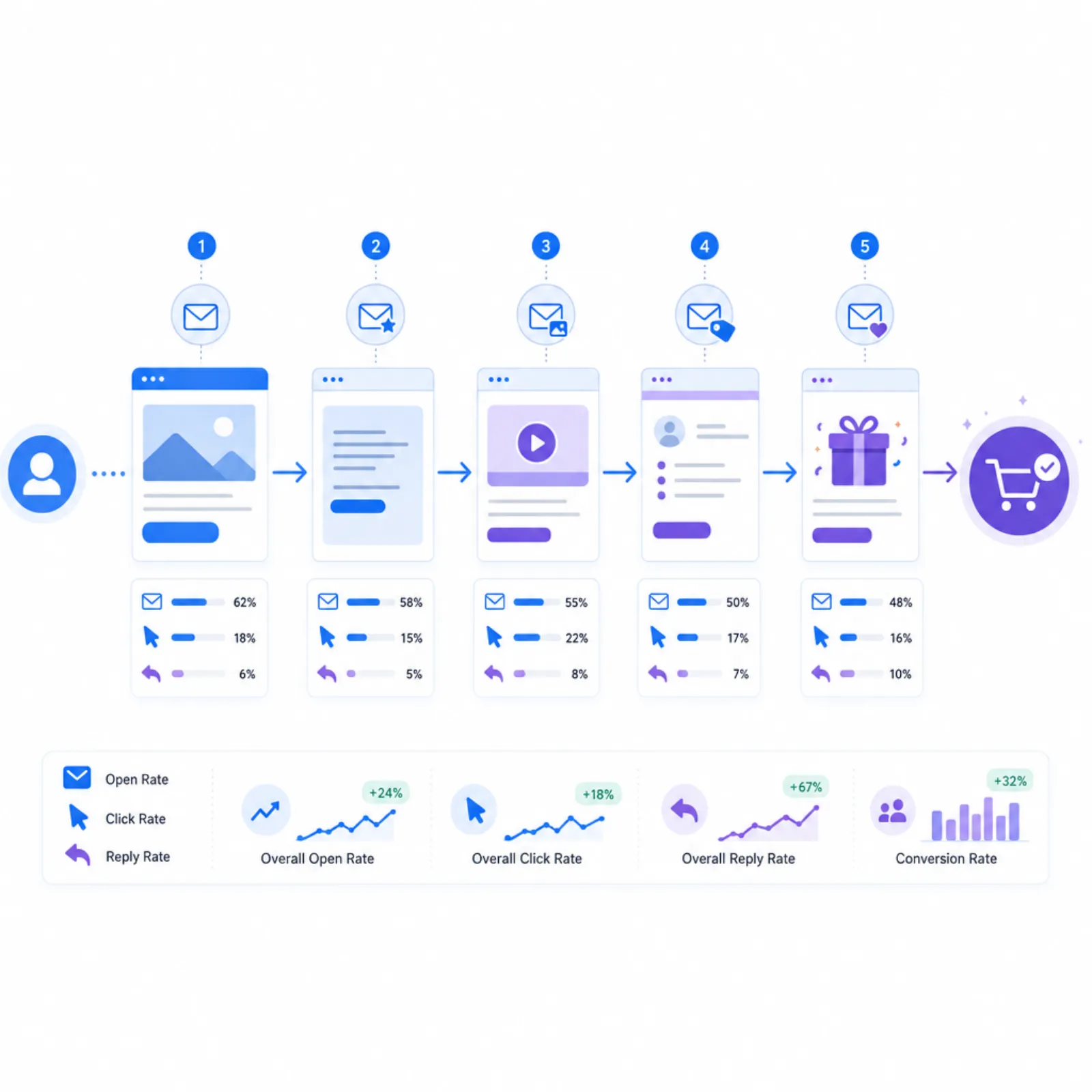
Basic Nurture Sequence
- Delivery email: Send the lead magnet immediately. Include a personal touch.
- Value email (Day 2-3): Share a related blog post or resource. No selling.
- Story email (Day 5-7): Share a case study or customer success story.
- Education email (Day 10-12): Teach something useful related to their pain point.
- Offer email (Day 14-15): Present your solution with a clear call to action.
The key is providing value before asking for anything. Each email should be useful on its own, not just a teaser for your product.
Step 6: Measure Content Marketing ROI
Content marketing for lead generation only works if you can prove it. Track these metrics:
Traffic Metrics
- Organic traffic growth (month over month)
- Traffic by content piece
- Keyword rankings and ranking improvements
Lead Metrics
- Leads generated per content piece
- Conversion rate by lead magnet
- Cost per lead (content production cost / leads generated)
- Lead quality score (what percentage become qualified?)
Revenue Metrics
- Revenue attributed to content-sourced leads
- Customer acquisition cost for content-sourced customers vs. other channels
- Lifetime value of content-sourced customers
Set up proper attribution in your analytics to connect content consumption to lead generation to revenue.
Content Marketing Lead Generation in Practice
Here's what a realistic content-driven lead generation engine looks like for a mid-size B2B company:
- 4 blog posts per month targeting strategic keywords
- 1 lead magnet per quarter (new or refreshed)
- Weekly email newsletter to the existing list
- Social distribution across 2 primary platforms
- Monthly performance review and content calendar adjustment
This isn't glamorous. It's consistent execution of a proven framework. The compound effect of regular content publication, combined with SEO optimization and lead capture, builds a predictable lead generation machine over 6-12 months.
Get Help Building Your Content Engine
At Atastic, we help businesses build content marketing systems that generate leads predictably. From content strategy development to execution and measurement, we can help you connect your content investment to real business results.
Talk to us about content-driven lead generation for your business.